
Ceiling Mounted Curtain Track for Dividers
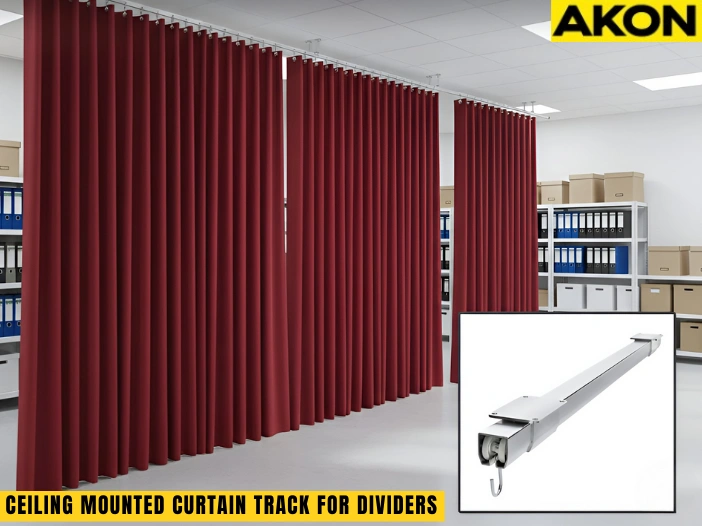
A ceiling mounted curtain track for dividers is an overhead system used to divide space without permanent walls. This guide explains what it is, where it’s used, why facilities choose it, how it compares to other mounting options, and which solutions work best for both standard and special ceiling types.
What Is a Ceiling Mounted Curtain Track for Dividers?
With the overall purpose established, this section takes a closer look at what a ceiling mounted curtain track is and how it functions within a space. Understanding the system itself helps clarify why it is widely used before comparing options or exploring solutions.
What a Ceiling Mounted Curtain Track Is
A ceiling mounted curtain track for dividers is an overhead rail designed to support sliding curtain panels along a fixed path. The track holds the curtain weight while allowing panels to move smoothly from open to closed positions.
This creates adjustable separation within a space without changing the structure of the room. All movement stays above the floor, keeping the layout open and unobstructed.
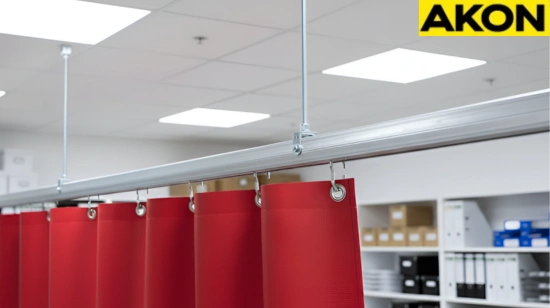
How Ceiling Mounted Tracks Differ from Other Dividers
Ceiling mounted tracks differ from wall or floor dividers by keeping all divider movement overhead. Wall-mounted systems depend on vertical surfaces, while floor-based dividers can interfere with movement below.
Overhead tracks eliminate these obstacles and help maintain clear walkways. This is why they are commonly used in industrial and commercial environments where uninterrupted floor space matters.
Make Shapes
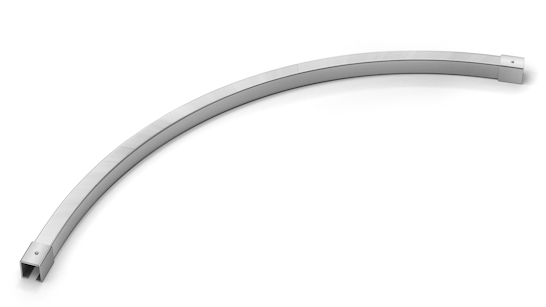
Radius Corner
By using a 90 degree radius corner you can go around obstructions or make shapes. The 24" radius corner quickly attaches and detaches as needed. Use 1 radius for an L-Shape design, 2 radius corners for a C-Shape and 4 radius corners for a complete enclosure.

Why Choose a Ceiling Mounted Curtain Track for Dividers
With a clear understanding of what the system is, the next step is deciding why it is often chosen over walls or fixed partitions. The value comes from how the space can function and adapt during daily use.
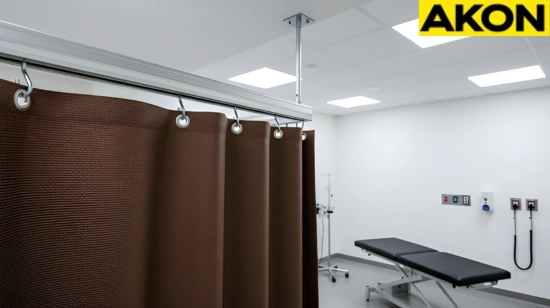
• Faster layout changes. Adjustments can be made quickly. There is no downtime waiting for construction or removal. Work continues without interruption.
• Better workflow control. Spaces can be managed more intentionally. Teams can separate tasks while maintaining visibility. This helps reduce congestion and confusion.
• Cost-conscious space division. Permanent walls require significant investment. Curtain systems provide separation without the same cost. This makes them practical for growing or changing facilities.
Maximizes Floor Space
Dividers stay overhead and off the floor. This keeps pathways clear for equipment, carts, and foot traffic.
Flexible Area Separation
Spaces can open or close when needed. Curtains allow areas to be separated for specific tasks and reopened afterward.
Built for Industrial Use
The system is designed for regular use. It supports frequent movement while maintaining smooth operation.
Ceiling Mount vs Other Curtain Track Mounting Options
Once the benefits of overhead curtain systems are clear, the next step is understanding which mounting option best fits your ceiling. Ceiling height, structure, and layout all influence how a curtain track should be supported, especially in industrial and commercial spaces with varying overhead conditions.
| Mounting Type | Best For | Key Advantage |
|---|---|---|
| Ceiling Mounted | Standard flat ceilings | Clean installation with minimal clearance |
| Threaded Rod Mounted | High ceilings | Adjustable drop height |
| Chain or Cable Mounted | Uneven or open ceilings | Flexible suspension |
| I-Beam Mounted | Industrial steel structures | Strong load support |
| Wall Mounted | Low or restricted ceilings | Side-mounted alternative |
Each mounting format addresses a different ceiling condition. Understanding these differences makes it easier to select a solution that fits properly and performs reliably in your space.
Types of Curtain Track Mounts
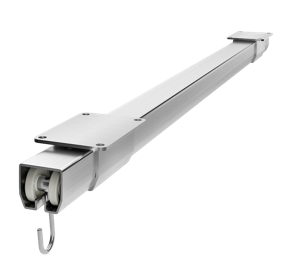
Ceiling Mount Curtain Track
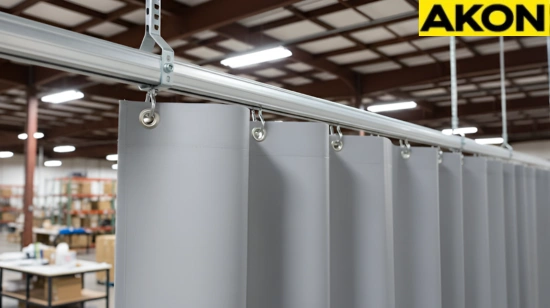
Choose this mounting style if you want your industrial curtain track to mount to the ceiling with only a few inches of open gap.
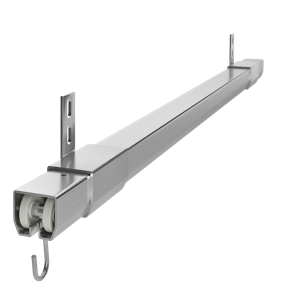
Wall Mount Curtain Track
This curtain track mount is designed for mounting the track next to a vertical wall or stud. This can be parallel to the wall, or perpendicular.
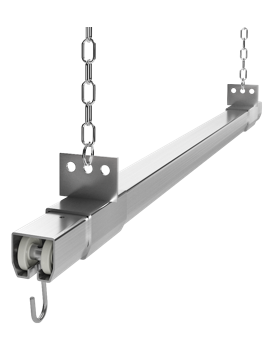
Chain or Cable Curtain Track
Like the threaded rod, a chain supported curtain track is also good for spanning large distances. Both chain or cable can be used to hold up the track.
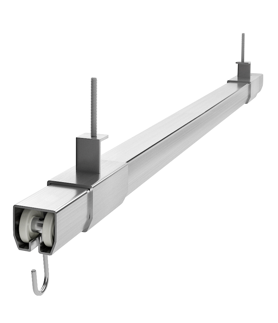
Threaded Rod Curtain Track
If the distance between the anchor points above is higher than where you want the curtain track, then a threaded rod mount might work well. Steel rods support the track and span the distance between the track and the ceiling.
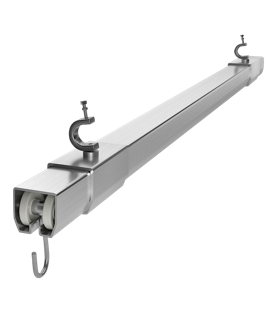
I-Beam Curtain Track
When connecting to a truss, I-Beam or any other horizontal steel support this style of mount works best. Once connected, you simply tighten down the set screw.
Ceiling Mounted Curtain Track Solutions for Standard and Special Ceilings
After knowing which mounting approach fits your ceiling, the next step is choosing a curtain track product that matches those conditions. The options below are commonly used across industrial and commercial spaces and are selected based on how the ceiling supports the track and how the system needs to operate overhead.
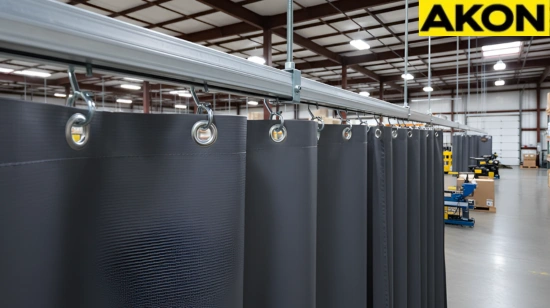
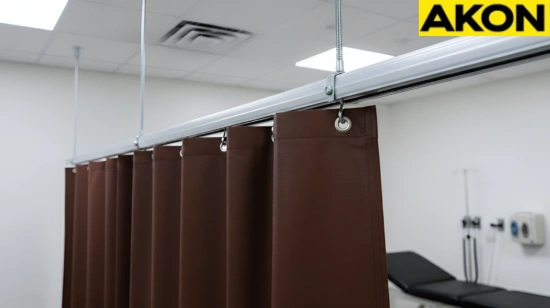
Ceiling Curtain Track
The Ceiling Curtain Track is intended for flat concrete or finished ceilings where the track can be mounted directly overhead. It is a straightforward option when a clean, low-profile setup is needed.
• Supports direct ceiling attachment without suspension
• Keeps the track positioned close to the ceiling surface
• Commonly used in standard industrial, commercial, and medical spaces
• Allows curtains to glide smoothly along straight track runs
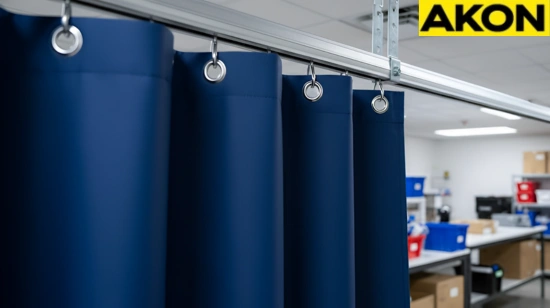
Chain Curtain Track
The Chain Curtain Track is used when ceilings are high, open, or uneven and the track must be lowered to an operating height. It provides a suspended solution that adapts to challenging overhead layouts.
• Designed for ceilings with obstructions or varying elevations
• Uses chain suspension to control track drop height
• Keeps the track level for consistent curtain movement
• Frequently applied in warehouses and large production areas
I-Beam Curtain Track
The I-Beam Curtain Track is built for facilities with exposed steel beams or structural framing. It mounts directly to the beam, offering a secure option for demanding environments.
• Attaches directly to steel beams without ceiling drilling
• Suitable for structural and heavy-duty industrial spaces
• Supports heavier curtain loads with steady operation
• Performs reliably in areas with frequent curtain movement
Frequently Asked Questions
FAQs: About Ceiling Mounted Curtain Track for Dividers
Can ceiling mounted curtain tracks work with high ceilings?
Yes. In high-ceiling spaces, a Chain Curtain Track is often used so the track can be suspended to the correct operating height. This keeps the system functional without mounting directly at the roof level.
What if my ceiling is uneven or not level?
Uneven ceilings can still support curtain tracks when suspension is used. Chain-based mounting allows the track to remain level even if the ceiling surface varies.
Are ceiling mounted curtain tracks suitable for open ceilings?
Yes. Open ceilings commonly use suspended mounting methods that position the track below exposed roof elements. This approach maintains smooth curtain operation without interfering with overhead structures.
What options are available if my ceiling has exposed beams?
When exposed steel beams are present, an I-Beam Curtain Track is typically used. It mounts directly to the beam, providing secure support without modifying the ceiling.
Can curtain tracks be mounted to trusses or structural framing?
Yes. Structural framing can support curtain tracks when beam-compatible mounting is used. This is common in warehouses and industrial facilities.
Can ceiling mounted curtain tracks be customized for special layouts?
Yes. Track systems can be configured for straight runs, corners, or segmented layouts. Custom configurations are often used in spaces with unique floor plans.
Can curtain tracks follow corners or directional changes?
Yes. Curtain tracks can be designed to follow layout changes as long as the mounting method supports the path. This is useful for dividing irregular spaces.
How much weight can ceiling mounted curtain track systems support?
Weight capacity depends on the track type and mounting method. Structural options like I-Beam Curtain Track are commonly used when heavier curtains are required.
Do heavier curtains require a specific mounting option?
Yes. Heavier curtains usually require structural or beam-mounted solutions. This ensures the system remains stable during frequent use.
Can ceiling mounted curtain tracks be used in busy industrial environments?
Yes. These systems are designed for regular movement and are commonly used in active industrial and production spaces.
Are ceiling mounted curtain tracks permanent installations?
They are securely mounted, but the layout can be adjusted or expanded if space requirements change. This makes them suitable for evolving facilities.
Can curtain track systems be extended later?
In many cases, yes. Track runs can often be extended or modified depending on the original mounting setup.
Do ceiling mounted tracks interfere with lights or overhead equipment?
They are planned to work around existing overhead elements. Suspended options allow the track to be positioned below lighting or ductwork.
What if my space has limited ceiling clearance?
For limited clearance, a Ceiling Curtain Track mounted directly to the ceiling is often used. This keeps the system compact and unobtrusive.
Are ceiling mounted curtain tracks suitable for medical or clean spaces?
Yes. They are commonly used in medical and controlled environments where temporary separation is needed without permanent walls.
How do I know which ceiling mount option is right for my space?
The best option depends on ceiling height, structure, and curtain weight. Reviewing these factors helps match the space to the correct track type.
Can curtain tracks be used in temporary or changing layouts?
Yes. Curtain track systems are often chosen for spaces that need to adapt over time. Layout changes can be made without structural reconstruction.
Does my ceiling need special preparation before installing a curtain track?
Preparation depends on ceiling type and mounting method. Structural ceilings, open ceilings, and flat ceilings each support different solutions.
Can ceiling mounted curtain tracks be combined with other partition systems?
Yes. Curtain tracks can be used alongside other dividers when planned as part of a larger layout strategy.
Who can help determine the right curtain track solution for my ceiling?
A supplier experienced with Ceiling Curtain Track, Chain Curtain Track, and I-Beam Curtain Track systems can help match the right product to your ceiling and layout.
Photo Gallery
A Reliable Divider Solution for Any Ceiling
Ceiling mounted curtain track systems offer a flexible and reliable way to divide space without permanent construction. Designed to adapt to both standard and special ceiling conditions, they support changing layouts while maintaining dependable operation. If you’re ready to move forward, explore ceiling mounted curtain track options to find a solution that fits your space.
Flexible Divider Zones
