
Curtain Track for Sloped Ceilings
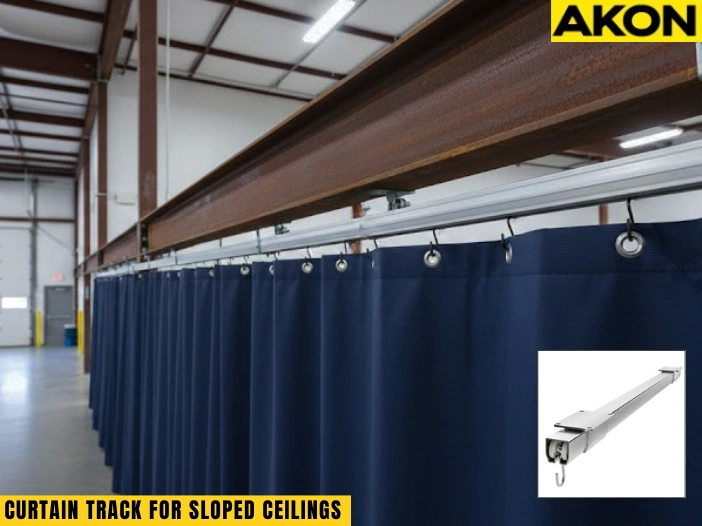
A curtain track for sloped ceilings is designed for angled, ceiling mounted, and special ceiling conditions. This guide explains why sloped ceilings present challenges, how curtain tracks can still work, and why keeping the track level using the right mounting method is essential for smooth, reliable operation.
Why Sloped and Special Ceilings Create Installation Challenges
Sloped and special ceilings change how curtain tracks behave once they are installed. Unlike flat ceilings, these conditions affect curtain movement and limit mounting options. Understanding these challenges helps explain why the right installation approach matters. It also sets the foundation for choosing the correct solution later in the guide.
How Gravity Affects Curtains on Sloped Ceilings
On sloped ceilings, gravity naturally pulls curtains toward the lowest point. When a curtain track follows the ceiling angle, curtains may slide on their own instead of staying in place.
This can cause uneven stacking and make it difficult to keep curtains open or closed where intended. Over time, this inconsistent movement can make daily use frustrating, even when quality materials are used.
Why Special Ceiling Conditions Complicate Installation
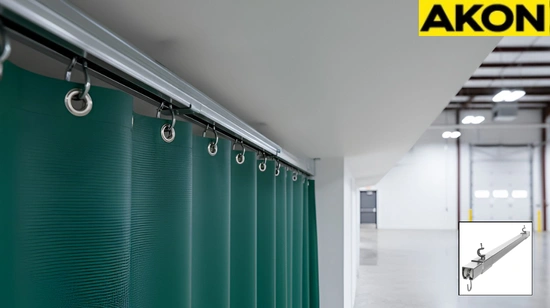
Special ceiling conditions such as vaulted ceilings, exposed beams, uneven surfaces, or changing ceiling heights limit where curtain tracks can be mounted. Direct ceiling mounting in these environments often leads to uneven alignment along the curtain run.
This can place uneven stress on the track and mounting hardware. Without proper planning and suitable hardware, curtain operation may feel unstable and affect long-term performance.
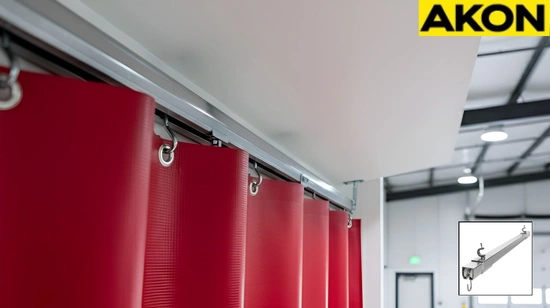
Make Shapes
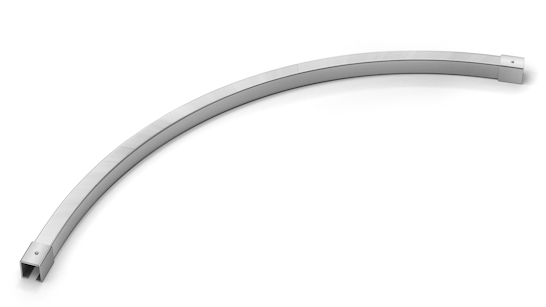
Radius Corner
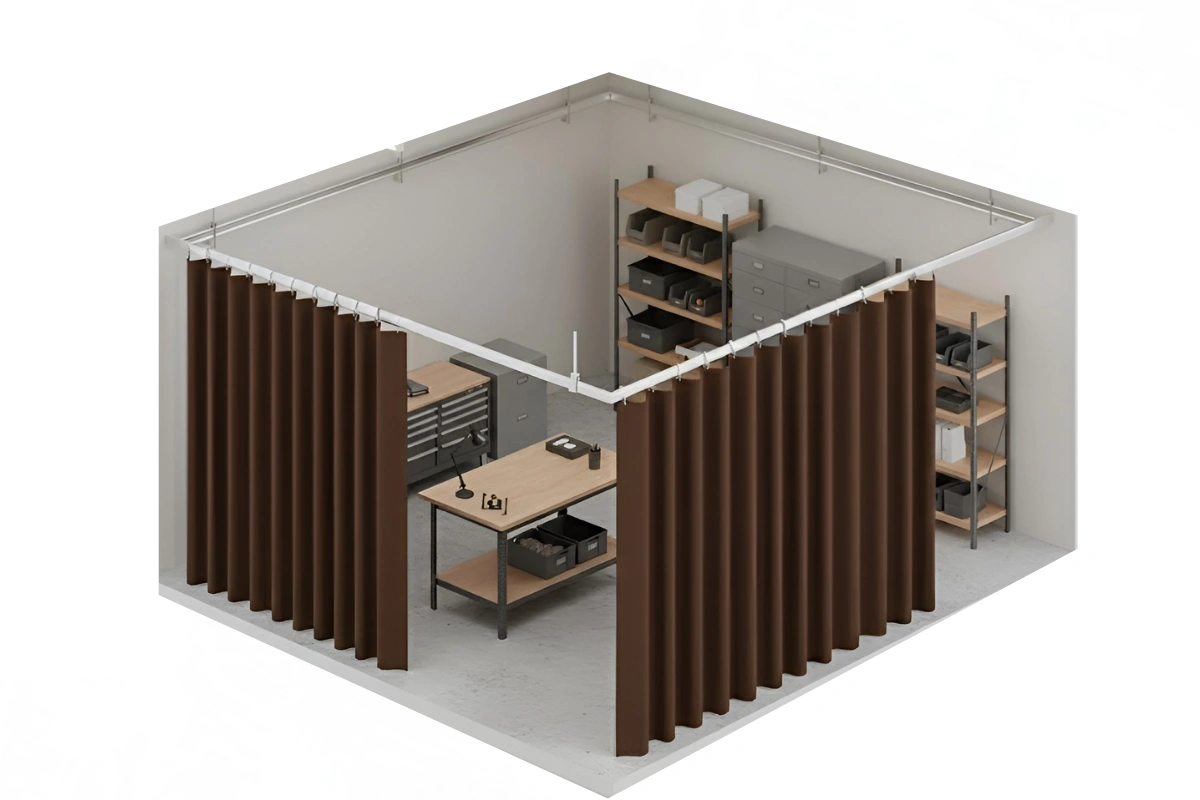
By using a 90 degree radius corner you can go around obstructions or make shapes. The 24" radius corner quickly attaches and detaches as needed. Use 1 radius for an L-Shape design, 2 radius corners for a C-Shape and 4 radius corners for a complete enclosure.

Key Benefits of Heavy Duty Curtain Track for Industrial Curtains
After knowing how standard track systems break down under industrial demands, the value of a heavy duty curtain track becomes clear. These systems are built to handle wide openings, heavy curtains, and daily use while keeping operations running smoothly.
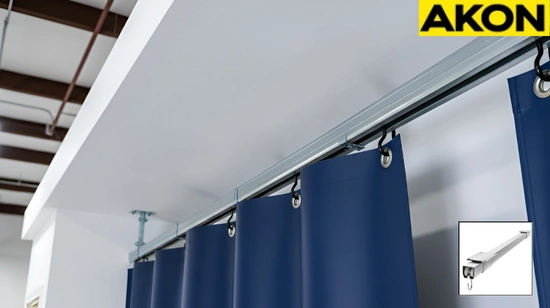
• Better coverage for wide openings. Heavy duty curtain track allows large doorways and open bays to be covered without permanent walls. This makes it easier to separate spaces while keeping access flexible. Facilities can adapt layouts without major construction.
• More predictable daily operation. Curtains move consistently along the track with fewer interruptions. This helps teams maintain steady workflow throughout the day. Reliable movement also reduces the need for constant adjustments.
• A system that supports future changes. Modular track designs make expansion easier as facility needs evolve. Additional sections can be added without replacing the entire system. This helps extend the life and value of the installation.
Level Performance
A properly mounted curtain track helps keep curtains in place and prevents unwanted movement on sloped or irregular ceilings.
Structural Reliability
Heavy-duty curtain track systems provide stable support for ceiling-mounted and suspended installations over time.
Installation Flexibility
Flexible mounting options allow curtain tracks to work across sloped, vaulted, exposed-beam, and other special ceiling layouts.
Mounting Options for Sloped, Ceiling Mounted, and Special Ceilings
Once you know the benefits of using the right curtain track, the next step is choosing a mounting method that fits your ceiling layout. Different ceiling conditions require different approaches, and selecting the right option helps ensure proper alignment and smooth operation. The table below outlines common mounting methods and when each one works best.
| Mounting Method | Best For | Key Advantage |
|---|---|---|
| Ceiling Mount | Mild slopes or flat ceiling sections | Clean, direct attachment to the ceiling |
| Threaded Rod Suspension | Steep slopes or vaulted ceilings | Keeps the track perfectly level |
| Chain or Cable Suspension | Irregular or hard-to-access ceilings | Adjustable height and flexible positioning |
| Beam Flange Mount | Exposed beams or structural ceilings | Extremely secure installation without drilling |
Each mounting option is designed to address a specific ceiling condition. By matching the mounting method to your space, you can create a setup that feels stable, functions smoothly, and performs reliably over time.
Types of Curtain Track Mounts
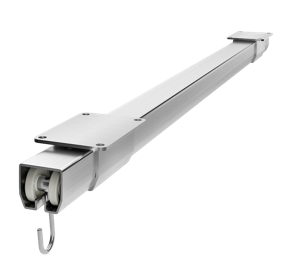
Ceiling Mount Curtain Track
Choose this mounting style if you want your industrial curtain track to mount to the ceiling with only a few inches of open gap.
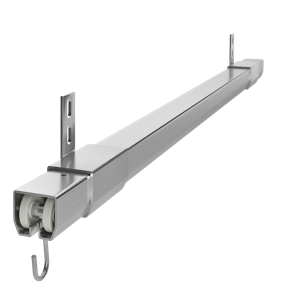
Wall Mount Curtain Track
This curtain track mount is designed for mounting the track next to a vertical wall or stud. This can be parallel to the wall, or perpendicular.
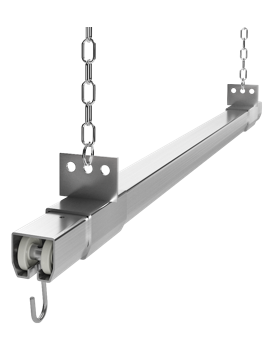
Chain or Cable Curtain Track
Like the threaded rod, a chain supported curtain track is also good for spanning large distances. Both chain or cable can be used to hold up the track.
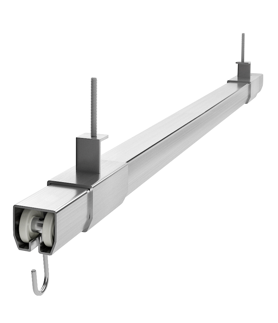
Threaded Rod Curtain Track
If the distance between the anchor points above is higher than where you want the curtain track, then a threaded rod mount might work well. Steel rods support the track and span the distance between the track and the ceiling.
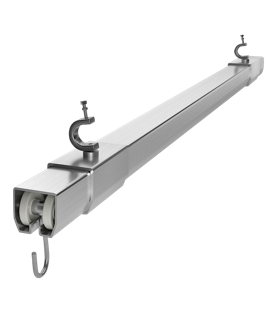
I-Beam Curtain Track
When connecting to a truss, I-Beam or any other horizontal steel support this style of mount works best. Once connected, you simply tighten down the set screw.
Recommended Curtain Track Products for Sloped and Special Ceilings
After knowing the mounting approach that fits your ceiling layout, the next step is selecting curtain track products that are designed to work with those conditions. The following options are commonly used in sloped, ceiling mounted, and special ceiling installations where reliability and compatibility matter.
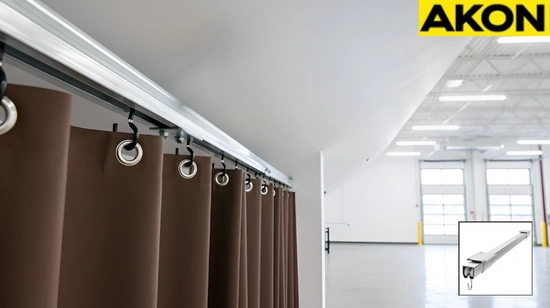
Ceiling Curtain Track
Ceiling curtain tracks are designed to attach directly to overhead structures in controlled ceiling layouts. They are a practical choice for mild slopes, flat sections, and ceiling-mounted configurations.
• Works with ceiling-mounted and suspended installations
• Creates a clean, low-profile appearance overhead
• Supports smooth curtain travel when properly aligned
• Suitable for both light-duty and heavy-duty curtain systems
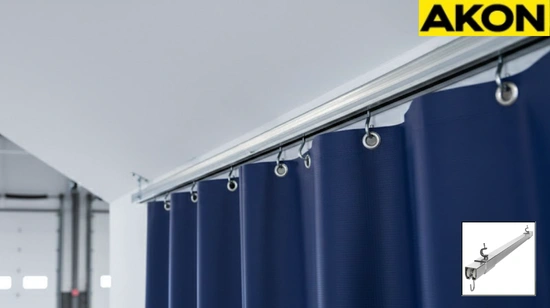
I-Beam Curtain Track
I-beam curtain track systems are ideal for spaces with exposed structural beams. They allow tracks to be secured directly to steel beams without altering the ceiling surface.
• Designed for exposed beam and open ceiling environments
• Uses beam clamps for secure attachment without drilling
• Helps maintain consistent alignment across wide spans
• Commonly used in industrial and commercial spaces
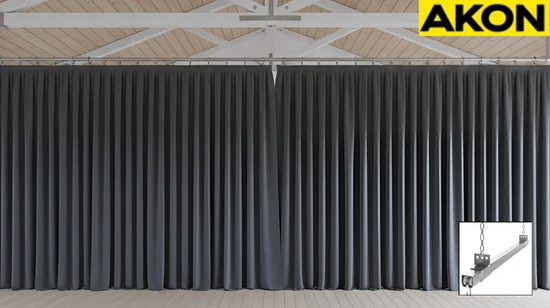
Chain Curtain Track
Chain curtain track systems suspend the track below the ceiling using adjustable chains or cables. This approach works well when direct ceiling mounting is limited or when ceiling heights and slopes vary.
• Allows flexible height adjustment beneath the ceiling structure
• Supports stable track positioning in uneven ceiling layouts
• Useful in tall or hard-to-access ceiling areas
• Adapts well to complex or changing ceiling conditions
Frequently Asked Questions
FAQs: Curtain Track for Sloped and Special Ceilings
Can curtain tracks be ceiling mounted on sloped ceilings?
Yes. A ceiling curtain track can be ceiling mounted on sloped ceilings when paired with the correct mounting method to keep the track aligned and functional.
Do curtain tracks need to be level on vaulted or angled ceilings?
In most cases, yes. Keeping a curtain track level helps prevent curtains from drifting and improves overall control during use.
What type of curtain track works best for exposed beam ceilings?
An I-beam curtain track is often the best option for exposed beam ceilings because it mounts directly to structural steel without altering the ceiling surface.
What is the best mounting option for special ceiling layouts?
The best mounting option depends on the ceiling structure and access. Ceiling-mounted, suspended, and beam-mounted systems are commonly used for special ceiling layouts.
Can heavy curtains be used on ceiling-mounted curtain tracks?
Yes. Heavy curtains can be supported by a ceiling curtain track when the track and hardware are rated for the load.
Are chain curtain tracks safe for commercial or industrial ceilings?
Yes. Chain curtain track systems are commonly used in commercial and industrial spaces where the track needs to stay level beneath sloped or uneven ceilings.
Do special ceilings require custom curtain track hardware?
Not always. Many installations use standard components such as chain curtain track hardware or I-beam mounting options.
Will curtains slide on their own if the ceiling is sloped?
They can if the track follows the ceiling angle. Using the proper mounting approach helps prevent unwanted movement.
Can curtain tracks be installed on uneven or mixed-height ceilings?
Yes. Special ceiling layouts with uneven heights can be accommodated using suspended or adjustable mounting systems.
What curtain track works best for tall ceilings?
Chain curtain track systems are often used for tall ceilings where direct ceiling mounting is difficult or impractical.
Are ceiling-mounted curtain tracks adjustable after installation?
Some ceiling-mounted and suspended systems allow adjustments depending on the hardware used.
Can curtain tracks span long distances on sloped ceilings?
Yes. Curtain track sections can be connected to span long distances when properly supported along the run.
Is professional installation recommended for special ceiling installs?
Professional installation is not always required, but it can help ensure proper alignment in complex ceiling environments.
Can curtain tracks be used in open-ceiling commercial spaces?
Yes. Open ceilings often pair well with I-beam curtain track or chain curtain track systems.
Do sloped ceilings limit curtain fabric or size options?
No. Curtain size and fabric selection depend more on track capacity and mounting support than ceiling angle.
Can curtain tracks be installed without drilling into finished ceilings?
In some cases, yes. I-beam curtain track systems allow mounting without drilling into finished ceiling surfaces.
Are ceiling-mounted curtain tracks suitable for frequent use?
Yes. When installed correctly, ceiling-mounted curtain track systems can handle frequent opening and closing.
How do I choose the right curtain track for my ceiling type?
Start by identifying whether your ceiling is sloped, exposed, or irregular, then match it with a ceiling curtain track, chain curtain track, or I-beam curtain track designed for that layout.
Can curtain tracks work around lights, ducts, or ceiling fixtures?
Yes. Flexible mounting options allow curtain tracks to be installed around common ceiling obstructions.
Are curtain track systems suitable for flexible or changing layouts?
Yes. Many curtain track systems allow repositioning or reconfiguration as space needs evolve.
Photo Gallery
Making Curtain Tracks Work on Any Ceiling
Sloped, ceiling-mounted, and special ceiling conditions can all support effective curtain track systems with the right planning. By choosing mounting methods and track systems that match the ceiling layout, it is possible to create a setup that performs reliably over time. Understanding your ceiling conditions and selecting compatible components allows you to move forward confidently, regardless of ceiling shape or structure.
Curtain Track Solution for Complex Ceiling