
Curtain Track for Sports Halls or Gyms
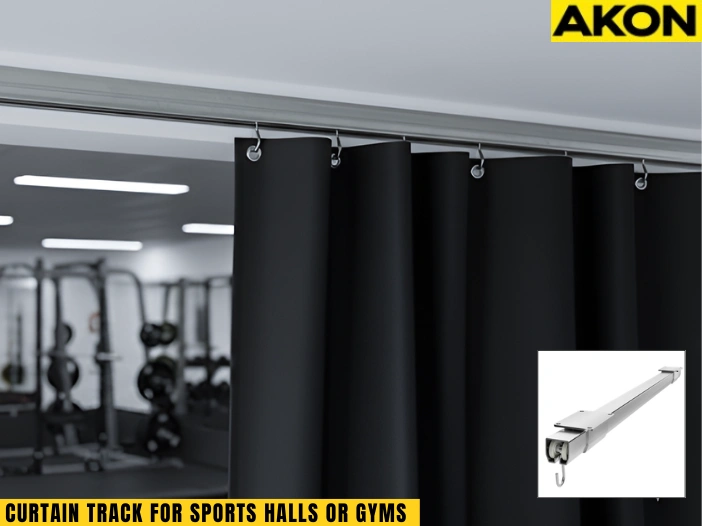
A curtain track system offers a flexible way to divide large interior spaces without permanent walls. This article explains why sports halls, gyms, and commercial venues use curtain tracks, where they are most effective, and what to consider when choosing a system, helping you decide if this solution fits your facility.
Why Sports Halls, Gyms, and Commercial Venues Need Curtain Track Systems
After knowing what curtain track systems are, it becomes easier to see why many facilities struggle without a flexible way to manage space. Sports halls, gyms, and commercial venues must balance changing activities while keeping environments organized, safe, and easy to control.
Managing Multi-Use Spaces and Simultaneous Activities
Large facilities are rarely used for just one purpose. The same open area may need to support practices, group classes, events, and general use throughout the day.
Without a clear way to divide space, noise overlaps, equipment competes for room, and schedules become harder to manage. Staff are often forced to limit access or stagger activities, which reduces efficiency and overall space utilization.
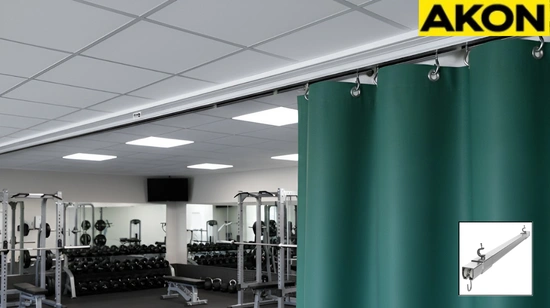
Safety, Crowd Flow, and the Limits of Fixed Layouts
Busy venues also face ongoing challenges related to safety and movement. When athletes, participants, and spectators share the same open space, congestion and distractions increase.
Managing traffic flow and maintaining clear boundaries becomes more difficult during peak hours. Permanent walls are not always practical, since fixed layouts limit future changes and require construction many facilities want to avoid.
Make Shapes
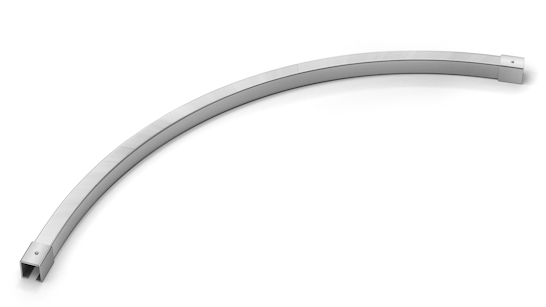
Radius Corner
By using a 90 degree radius corner you can go around obstructions or make shapes. The 24" radius corner quickly attaches and detaches as needed. Use 1 radius for an L-Shape design, 2 radius corners for a C-Shape and 4 radius corners for a complete enclosure.

Curtain Track for Sports Halls or Gyms: Key Benefits
Once the space challenges are understood, the practical advantages of a curtain track system become clear. These benefits focus on improving daily operations while keeping layouts adaptable and easy to manage.
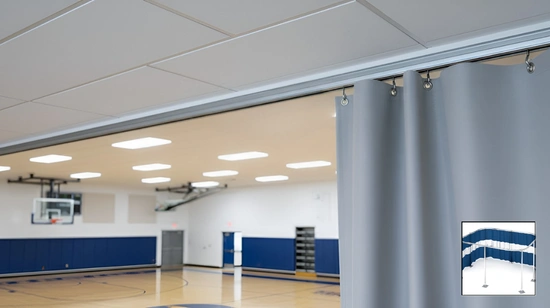
• Faster transitions between activities. Layout changes can be made quickly without disrupting schedules. Staff can adjust spaces between sessions with minimal effort. This keeps activities running on time throughout the day.
• Better use of available floor space. Facilities can divide only the areas they need instead of closing off entire rooms. Multiple programs can operate within the same footprint. Over time, this leads to more efficient space planning.
• Cleaner and more organized layouts. Defined zones make it easier for users to understand where activities belong. Equipment and foot traffic stay more contained. This improves the overall experience for staff and visitors alike.
Safety & Separation
Creates clear boundaries that help maintain safer, more controlled activity zones.
Flexible Space Use
Allows areas to be divided and reopened quickly as schedules and needs change.
Built for Heavy Daily Use
Designed to perform reliably with frequent movement in high-traffic environments.
Common Applications in Sports Halls, Gyms, and Commercial Venues
With the key benefits in mind, it becomes easier to see how curtain track systems are used in real facility settings. These applications show where flexible space division makes the biggest difference in day-to-day operations.
| Use Case | How It Helps |
|---|---|
| Dividing multi-sport courts | Supports simultaneous games or practices by separating activity zones |
| Practice areas with netting | Creates protected training zones for drills and focused practice |
| Group fitness or class separation | Allows parallel sessions to run in shared spaces |
| Equipment or storage separation | Keeps traffic organized and active areas clear |
| Event or spectator zones | Defines boundaries during competitions or special events |
These examples help facility managers visualize how a single open space can support multiple functions throughout the day. Whether the environment is a sports hall, gym, or commercial venue, curtain track systems adapt to changing needs without requiring permanent structural changes.
Types of Curtain Track Mounts
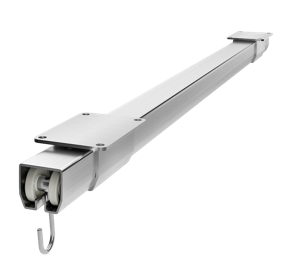
Ceiling Mount Curtain Track
Choose this mounting style if you want your industrial curtain track to mount to the ceiling with only a few inches of open gap.
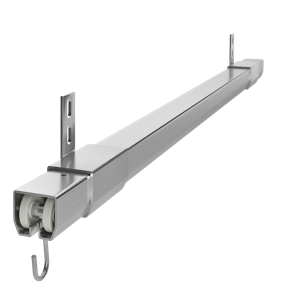
Wall Mount Curtain Track
This curtain track mount is designed for mounting the track next to a vertical wall or stud. This can be parallel to the wall, or perpendicular.
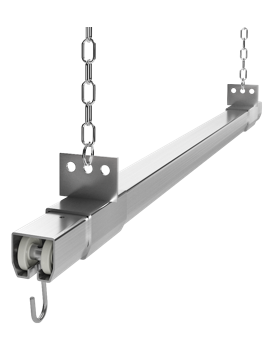
Chain or Cable Curtain Track
Like the threaded rod, a chain supported curtain track is also good for spanning large distances. Both chain or cable can be used to hold up the track.
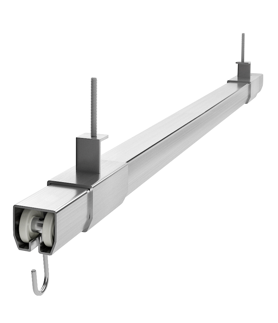
Threaded Rod Curtain Track
If the distance between the anchor points above is higher than where you want the curtain track, then a threaded rod mount might work well. Steel rods support the track and span the distance between the track and the ceiling.
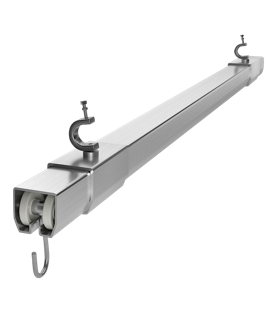
I-Beam Curtain Track
When connecting to a truss, I-Beam or any other horizontal steel support this style of mount works best. Once connected, you simply tighten down the set screw.
Recommended Curtain Track Solutions for Gyms and Commercial Venues
Now that you know how curtain track systems are applied in real facilities, the next step is choosing the right setup for your space. The best option depends on your building structure, activity level, and how often layouts need to change.
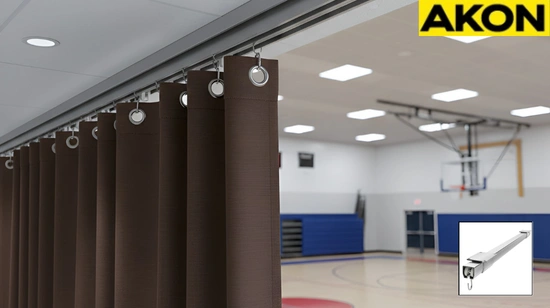
Ceiling Curtain Track
Ceiling curtain track systems are a strong fit for sports halls, gyms, and large commercial venues. Their overhead mounting keeps the floor open while supporting flexible space division.
• Works well in large, open interiors with high ceilings
• Keeps floors clear for sports, equipment, and foot traffic
• Supports frequent layout changes throughout the day
• Commonly used for courts, fitness zones, and multipurpose areas
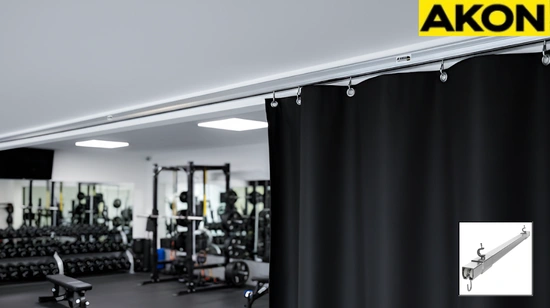
I-Beam Curtain Track
I-beam curtain track systems are ideal for facilities with exposed beams or structural supports. They provide a secure mounting option in spaces that demand stability and consistent performance.
• Attaches directly to existing I-beams or overhead structures
• Suitable for large courts and heavy-use athletic areas
• Handles frequent opening and closing without disruption
• Often used in industrial-style gyms and recreation halls
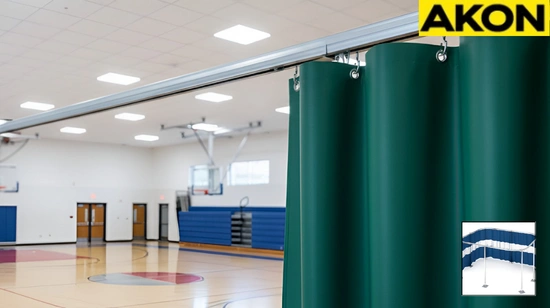
Free Standing Track
Free standing track systems offer flexibility when ceiling or wall mounting is not available. They allow facilities to create temporary
divisions without making permanent changes to the building.
• Does not require ceiling or wall installation
• Useful for rented spaces or temporary layouts
• Easy to reposition as facility needs change
• Well suited for events, pop-up zones, and adaptable commercial spaces
Frequently Asked Questions
FAQs: Curtain Track for Sports Halls or Gyms
Are curtain track systems suitable for both gyms and commercial venues?
Yes. Curtain track systems are commonly used in gyms, sports halls, and commercial venues such as recreation centers and event spaces that need flexible layouts.
Are curtain track systems strong enough for daily use in busy facilities?
They are designed for environments with frequent opening and closing. This makes them a reliable option for high-traffic gyms and commercial venues that operate throughout the day.
Can curtain track systems support sports netting in training areas?
Yes. Curtain track systems are often paired with sports netting for drills, practice zones, and ball containment in athletic facilities.
Are curtain tracks suitable for school gyms and community centers?
They are widely used in schools and community facilities because they allow one space to serve multiple programs without permanent construction.
Can curtain track systems be reconfigured if facility needs change?
Yes. Curtain track systems are chosen for their ability to adapt, allowing facilities to adjust layouts as schedules, programs, or usage change.
Do curtain track systems require permanent walls or renovations?
No. These systems divide space without permanent walls, making them a practical choice for facilities that need flexibility.
Which curtain track system works best for large sports halls?
Ceiling curtain track and I-beam curtain track systems are commonly used in large sports halls where wide openings or long spans need to be divided.
Can multiple curtain track systems be installed in one facility?
Yes. Many facilities use multiple curtain track systems to divide courts, training areas, and event zones independently.
Are curtain track systems compatible with high ceilings?
Yes. Ceiling curtain track and I-beam curtain track systems are well suited for gyms and sports halls with high or open ceilings.
Can curtain track systems be used for temporary events or tournaments?
Yes. Free standing track systems are often used for temporary layouts in events, competitions, or special programs.
Are curtain track systems easy for staff to operate?
They are designed for smooth, straightforward operation so staff can open or close sections as needed throughout the day.
What curtain track option works best in rented facilities?
Free standing track systems are a good choice for rented or shared spaces where ceiling or wall mounting is not allowed.
Do curtain track systems help keep facilities organized?
Yes. Clearly defined zones help guide movement, reduce confusion, and keep equipment and activities contained.
Can curtain tracks be installed above courts or workout areas?
Yes. Ceiling-mounted systems are commonly installed above courts, fitness zones, and training areas to divide space overhead.
Are curtain track systems suitable for spectator or event boundaries?
They are often used to define spectator zones, staging areas, or restricted sections during events and competitions.
Can curtain track systems be expanded later?
Many facilities choose systems that allow additional track sections to be added as space needs grow.
Do curtain track systems work in non-athletic commercial spaces?
Yes. Wall curtain track and ceiling curtain track systems are also used in commercial venues that need adaptable layouts.
Are curtain track systems a long-term solution for space division?
They are commonly selected as a long-term option because they adapt to changing uses without rebuilding or permanent alterations.
Can different curtain or net types be used with these systems?
Curtain track systems can support different curtain or net setups depending on how the space is used.
How do I choose the right curtain track system for my facility?
The right system depends on ceiling structure, space size, and usage frequency. Many facilities compare ceiling curtain track, I-beam curtain track, and free standing track options to find the best fit.
Photo Gallery
A Flexible Space Solution for Active and Commercial Facilities
Curtain track systems give sports halls, gyms, and commercial venues a flexible way to divide and manage space without permanent construction. As facility needs change throughout the day or over time, these systems support adaptable layouts that remain easy to operate and maintain. For venues looking to improve space use now while staying prepared for future demands, choosing the right curtain track solution is a practical and forward-thinking step.
Flexible Training Zones in Gyms
