
Curtain Track for Hotels and Care Facilities
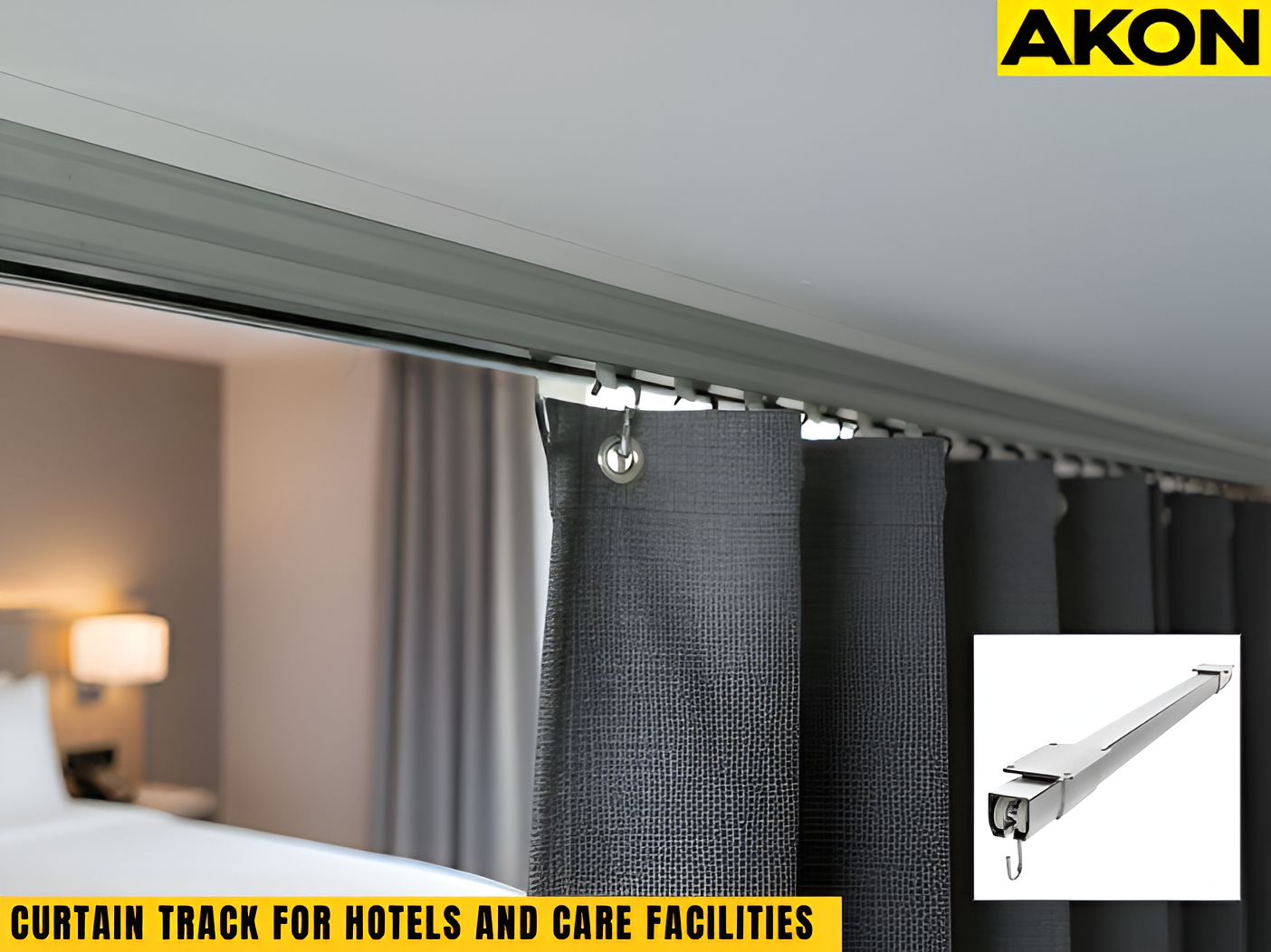
Curtain track systems support curtains in hotels, care facilities, and commercial venues where privacy, frequent use, and reliability matter. This article outlines the key needs of these environments, compares curtain track options, highlights suitable systems, and explains what to consider when choosing a track designed for professional, high-use spaces.
Key Needs in Hotels, Care Facilities, and Commercial Venues
Once curtain track systems are in use, they become part of everyday operations. In hotels, care facilities, and commercial venues, curtains are opened and closed repeatedly across many areas, creating specific demands that affect privacy, comfort, and overall functionality.
Operational Demands in High-Use Spaces
Curtains in professional environments experience constant movement throughout the day. Guest rooms, patient areas, work zones, and public-facing spaces all place ongoing strain on curtain systems.
Over time, frequent use can lead to wear, uneven movement, or increased maintenance needs. Noise is also a concern, as rough or loud operation can disrupt rest, focus, and the overall experience in busy facilities.
Privacy and Layout Requirements Across Facilities
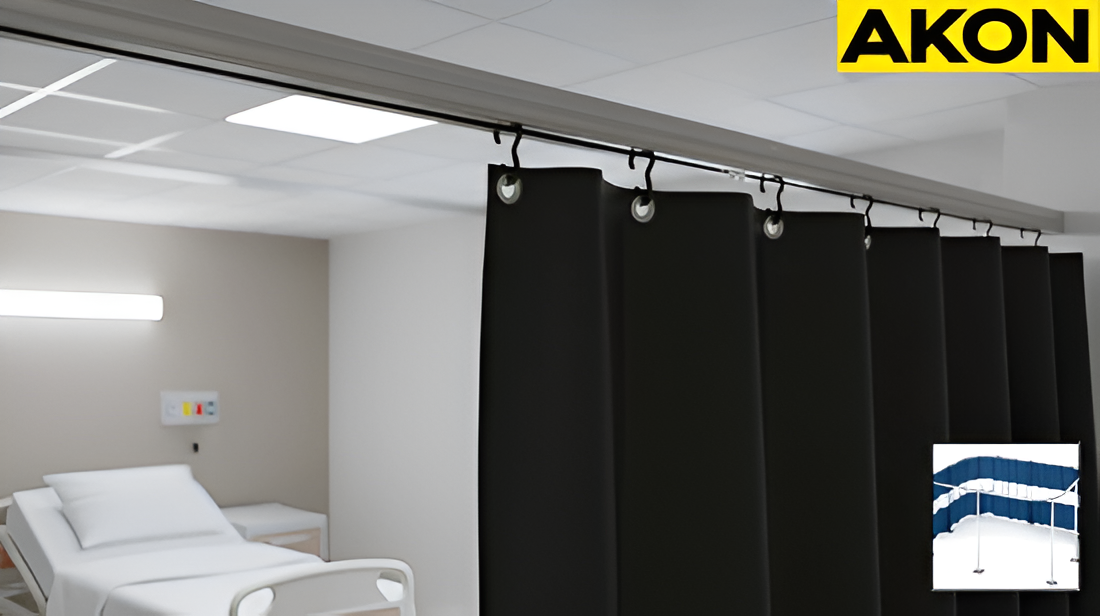
Privacy plays a central role in how these spaces function. Hotels depend on curtains to provide discretion for guests, while care facilities rely on them to protect patient dignity in treatment and recovery areas.
In commercial venues, curtains are often used to divide shared spaces or control visibility. At the same time, varying room sizes, open areas, and flexible zones require curtain systems that can adapt to different layouts.
Make Shapes
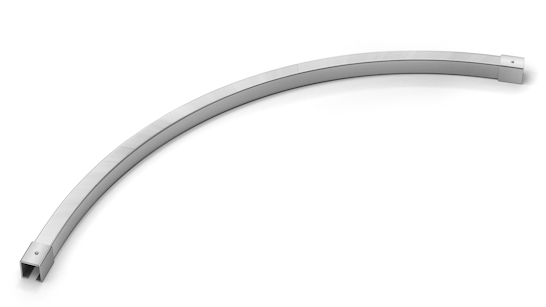
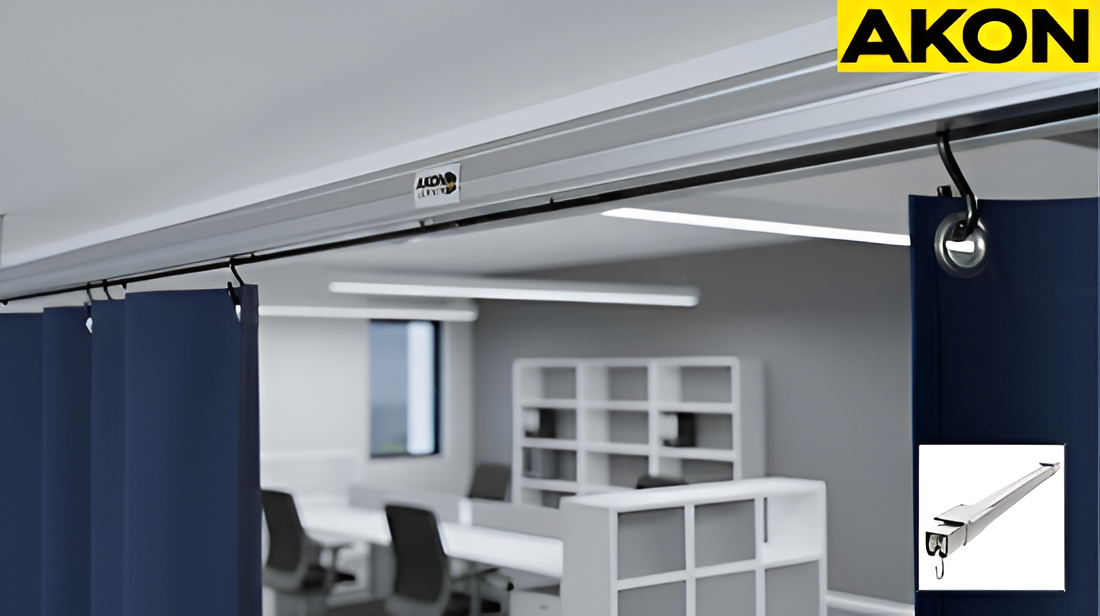
Radius Corner
By using a 90 degree radius corner you can go around obstructions or make shapes. The 24" radius corner quickly attaches and detaches as needed. Use 1 radius for an L-Shape design, 2 radius corners for a C-Shape and 4 radius corners for a complete enclosure.

How Industrial Curtain Tracks Solve These Needs
Industrial curtain tracks are designed for environments where curtains are used every day. These systems focus on consistent performance, comfort, and flexibility across hotels, care facilities, and commercial venues.
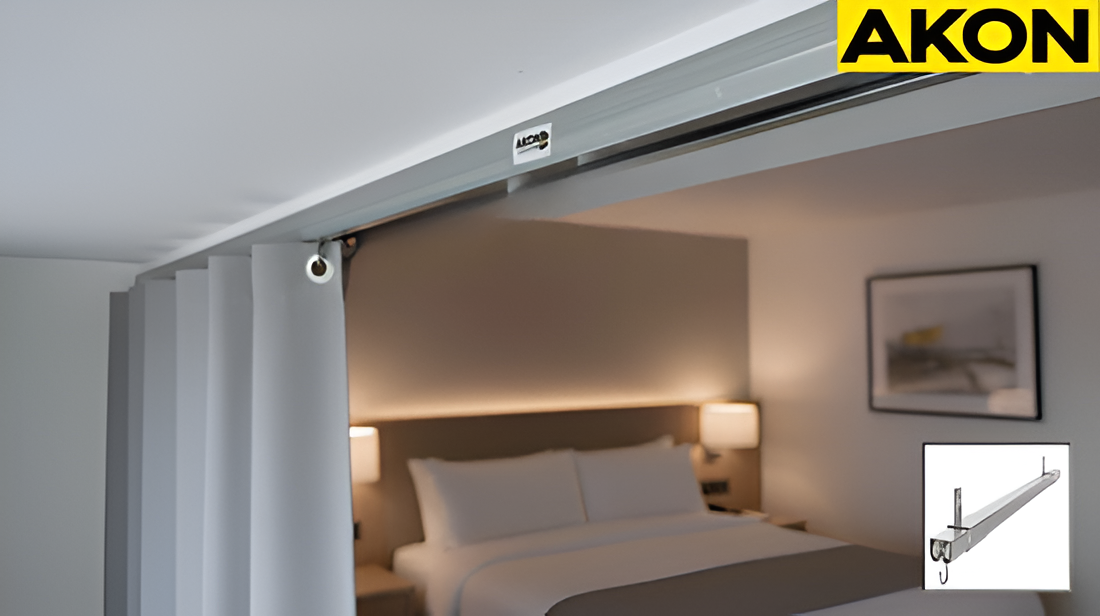
• Reliable performance over time. Industrial curtain tracks are built to maintain consistent operation with regular use. This helps reduce unexpected interruptions during daily activities. Facilities benefit from systems that continue working as expected year after year.
• A clean and professional appearance. Curtain track systems are designed to blend into a wide range of environments. This supports a polished look in guest rooms, patient areas, and commercial spaces. A tidy installation also contributes to a more organized setting.
• Flexibility for changing space needs. Many facilities adjust layouts as needs evolve. Curtain track systems allow spaces to be reconfigured without permanent construction. This makes it easier to adapt areas while keeping operations running smoothly.
Built for Daily Use
Designed to support frequent opening and closing without performance issues.
Smooth and Quiet Movement
Allows curtains to glide easily without creating unnecessary noise.
Fits Any Room Layout
Configurable track layouts adapt to different room sizes and space designs.
Which Curtain Track Is Right for Your Facility?
After knowing how industrial curtain tracks address daily operational needs, the next step is choosing the right option for your space. Curtain track systems vary in design and performance, and selecting the right type can impact durability, noise levels, and long-term upkeep. This comparison highlights the practical differences that matter most in hotels, care facilities, and commercial venues.
| Use Case | How It Helps |
|---|---|
| Dividing multi-sport courts | Supports simultaneous games or practices by separating activity zones |
| Practice areas with netting | Creates protected training zones for drills and focused practice |
| Group fitness or class separation | Allows parallel sessions to run in shared spaces |
| Equipment or storage separation | Keeps traffic organized and active areas clear |
| Event or spectator zones | Defines boundaries during competitions or special events |
This side-by-side comparison helps clarify why industrial curtain tracks are often the preferred choice in professional environments where reliability, adaptability, and long-term performance are essential.
Types of Curtain Track Mounts
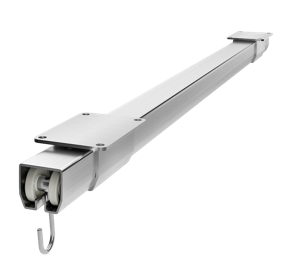
Ceiling Mount Curtain Track
Choose this mounting style if you want your industrial curtain track to mount to the ceiling with only a few inches of open gap.
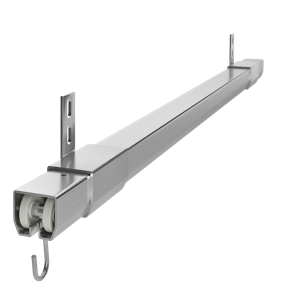
Wall Mount Curtain Track
This curtain track mount is designed for mounting the track next to a vertical wall or stud. This can be parallel to the wall, or perpendicular.
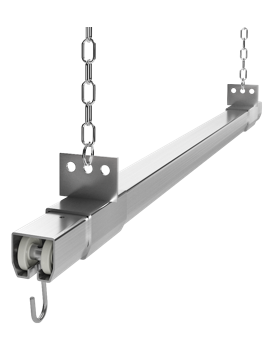
Chain or Cable Curtain Track
Like the threaded rod, a chain supported curtain track is also good for spanning large distances. Both chain or cable can be used to hold up the track.
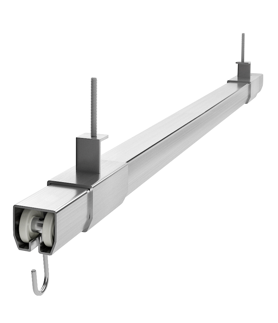
Threaded Rod Curtain Track
If the distance between the anchor points above is higher than where you want the curtain track, then a threaded rod mount might work well. Steel rods support the track and span the distance between the track and the ceiling.
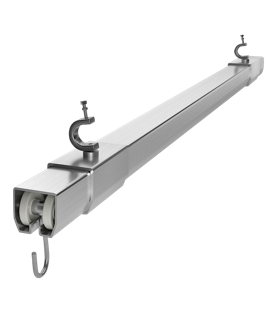
I-Beam Curtain Track
When connecting to a truss, I-Beam or any other horizontal steel support this style of mount works best. Once connected, you simply tighten down the set screw.
Recommended Curtain Track Products
After comparing curtain track options, the next step is selecting systems that fit how your space is actually used. The following curtain track options are commonly chosen for hotels, care facilities, and commercial venues because they work well in real, day-to-day environments.
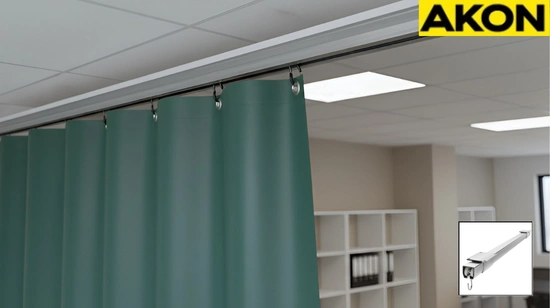
Ceiling Curtain Track
Ceiling curtain tracks are a practical choice when overhead mounting is available and floor space needs to remain clear. They are often used where a clean, unobtrusive installation supports a professional setting.
• Well suited for hotel guest rooms, patient areas, and shared commercial spaces
• Keeps curtain hardware out of walkways and working areas
• Supports consistent layouts with fixed zones and room divisions
• Commonly used where ceiling structure allows direct mounting
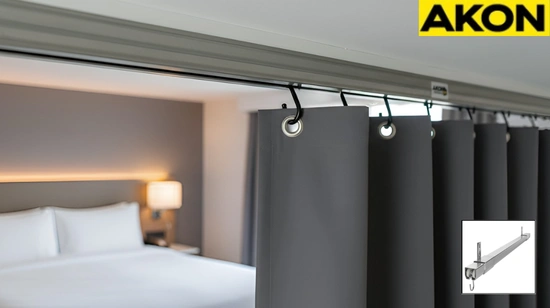
Wall Curtain Track
Wall curtain tracks are ideal when ceiling installation is not practical or when side mounting is preferred. They offer a dependable option for spaces with architectural or structural limitations.
• Useful in corridors, alcoves, and rooms with limited ceiling access
• Allows curtains to divide spaces without overhead hardware
• Fits well in commercial venues with defined wall boundaries
• Often chosen for retrofits or existing buildings
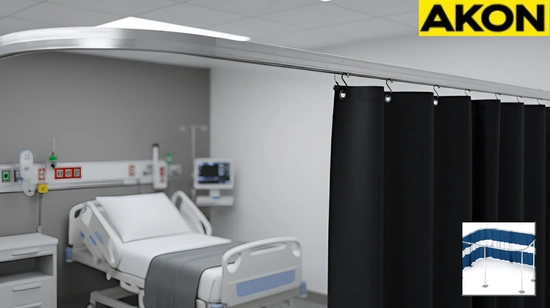
Free Standing Track
Free standing tracks provide flexibility when permanent mounting is not possible. They are commonly used in spaces that need temporary or adjustable curtain placement.
• Suitable for multi-purpose rooms and changing commercial layouts
• Allows curtain use without modifying walls or ceilings
• Helpful for facilities that reconfigure spaces as needs change
• Supports separation in areas where structural mounting is unavailable
Frequently Asked Questions
FAQs: Curtain Track for Sports Halls or Gyms
Are curtain track systems suitable for both gyms and commercial venues?
Yes. Curtain track systems are commonly used in gyms, sports halls, and commercial venues such as recreation centers and event spaces that need flexible layouts.
Are curtain track systems strong enough for daily use in busy facilities?
They are designed for environments with frequent opening and closing. This makes them a reliable option for high-traffic gyms and commercial venues that operate throughout the day.
Can curtain track systems support sports netting in training areas?
Yes. Curtain track systems are often paired with sports netting for drills, practice zones, and ball containment in athletic facilities.
Are curtain tracks suitable for school gyms and community centers?
They are widely used in schools and community facilities because they allow one space to serve multiple programs without permanent construction.
Can curtain track systems be reconfigured if facility needs change?
Yes. Curtain track systems are chosen for their ability to adapt, allowing facilities to adjust layouts as schedules, programs, or usage change.
Do curtain track systems require permanent walls or renovations?
No. These systems divide space without permanent walls, making them a practical choice for facilities that need flexibility.
Which curtain track system works best for large sports halls?
Ceiling curtain track and I-beam curtain track systems are commonly used in large sports halls where wide openings or long spans need to be divided.
Can multiple curtain track systems be installed in one facility?
Yes. Many facilities use multiple curtain track systems to divide courts, training areas, and event zones independently.
Are curtain track systems compatible with high ceilings?
Yes. Ceiling curtain track and I-beam curtain track systems are well suited for gyms and sports halls with high or open ceilings.
Can curtain track systems be used for temporary events or tournaments?
Yes. Free standing track systems are often used for temporary layouts in events, competitions, or special programs.
Are curtain track systems easy for staff to operate?
They are designed for smooth, straightforward operation so staff can open or close sections as needed throughout the day.
What curtain track option works best in rented facilities?
Free standing track systems are a good choice for rented or shared spaces where ceiling or wall mounting is not allowed.
Do curtain track systems help keep facilities organized?
Yes. Clearly defined zones help guide movement, reduce confusion, and keep equipment and activities contained.
Can curtain tracks be installed above courts or workout areas?
Yes. Ceiling-mounted systems are commonly installed above courts, fitness zones, and training areas to divide space overhead.
Are curtain track systems suitable for spectator or event boundaries?
They are often used to define spectator zones, staging areas, or restricted sections during events and competitions.
Can curtain track systems be expanded later?
Many facilities choose systems that allow additional track sections to be added as space needs grow.
Do curtain track systems work in non-athletic commercial spaces?
Yes. Wall curtain track and ceiling curtain track systems are also used in commercial venues that need adaptable layouts.
Are curtain track systems a long-term solution for space division?
They are commonly selected as a long-term option because they adapt to changing uses without rebuilding or permanent alterations.
Can different curtain or net types be used with these systems?
Curtain track systems can support different curtain or net setups depending on how the space is used.
How do I choose the right curtain track system for my facility?
The right system depends on ceiling structure, space size, and usage frequency. Many facilities compare ceiling curtain track, I-beam curtain track, and free standing track options to find the best fit.
Photo Gallery
Choosing the Right Curtain Track for Professional Environments
Industrial curtain tracks are a practical choice for hotels, care facilities, and commercial venues where curtains are used daily and dependable performance is essential. Designed for frequent use, quiet operation, and adaptable layouts, these systems support professional environments that rely on effective space separation and long-term functionality.
Guest Room Setting
