
Track Hardware Applications
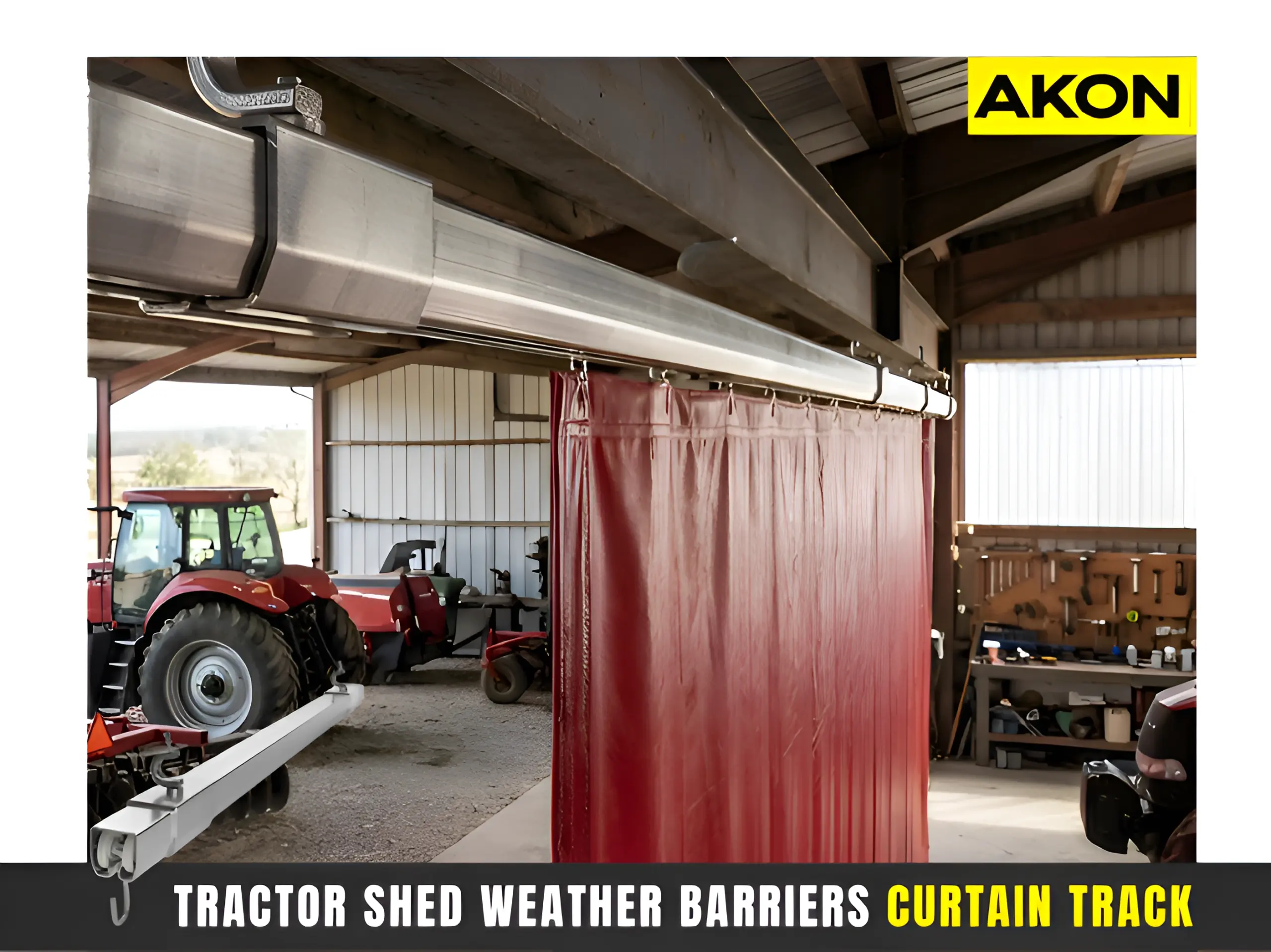
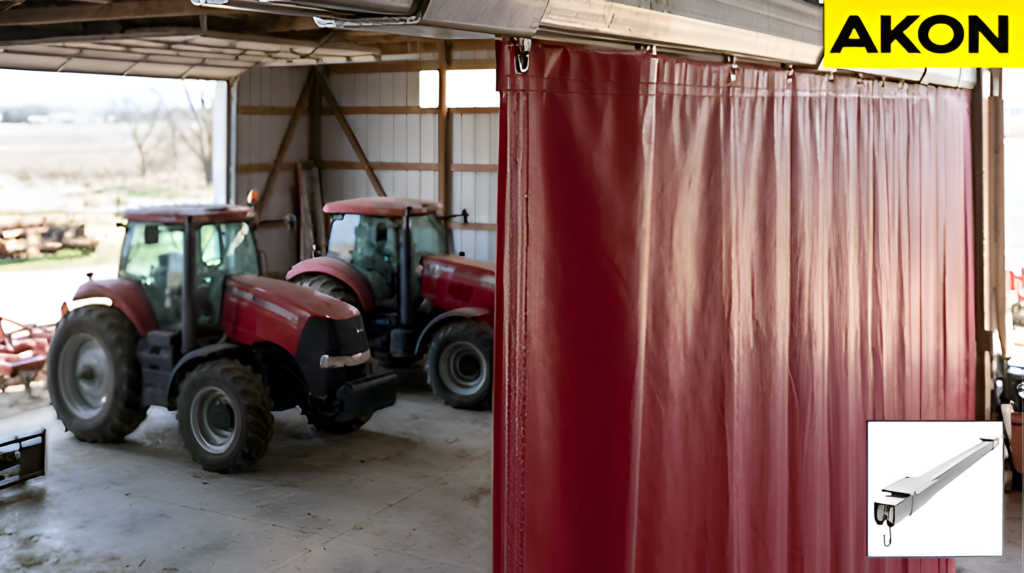
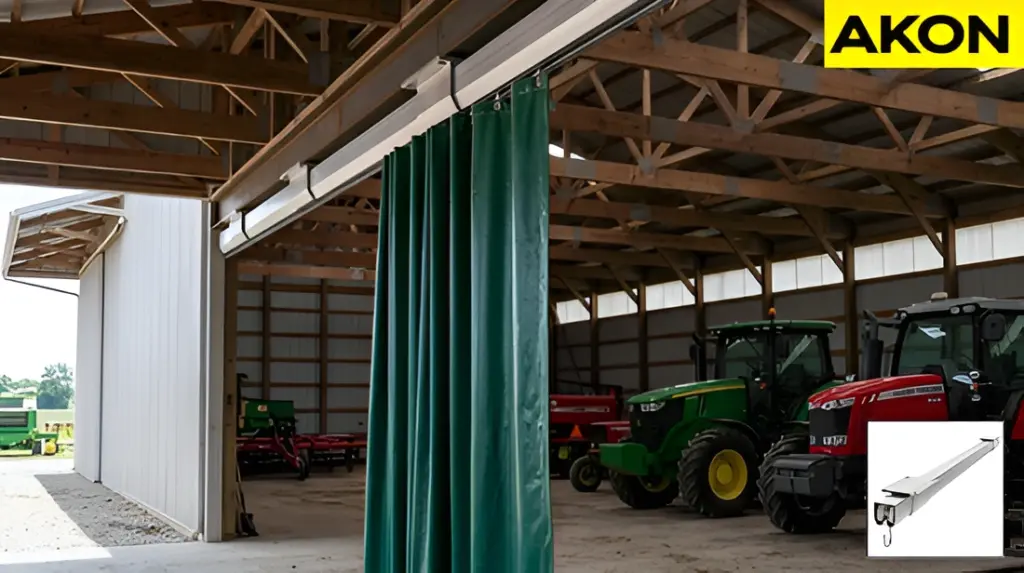
Tractor sheds often have large open bays that allow tractors and implements to move freely but also expose equipment to rain, snow, and debris. Sliding weather barriers supported by industrial curtain track hardware provide protection while maintaining access. This guide explains how track systems support weather barriers, shows a real installation example, compares configurations, and helps choose the right system.
The Real Problem: Tractor Shed Openings Are Hard to Protect
Once equipment begins using these wide shed openings daily, another challenge becomes clear: protecting machinery from weather without slowing down operations. Tractor sheds must stay open enough for large equipment to move freely, yet still provide protection when conditions turn rough.

Open Shed Bays Allow Wind-Driven Rain Inside
• Storm winds can push rain deep into the shed interior.
• Water can reach tractors, implements, and stored tools.
• Moisture exposure can increase maintenance and corrosion risk.
Equipment Near the Opening Often Gets Wet
• Tractors and attachments are commonly parked near the entrance for quick access.
• Equipment stored closest to the opening receives the most weather exposure.
• Repeated moisture exposure can affect sensitive components over time.

Large Machinery Requires Wide Access Openings
• Farm equipment needs large, unobstructed openings to move safely.
• Narrow entrances can slow down equipment movement during busy work periods.
• Tractor sheds are often designed around these wide operational clearances.
Traditional Doors Can Block Tractor Access
• Large doors may interfere with equipment movement or storage space.
• Heavy doors can be difficult to open quickly during daily operations.
• Fixed doors reduce the flexibility that open tractor sheds provide.
Make Shapes
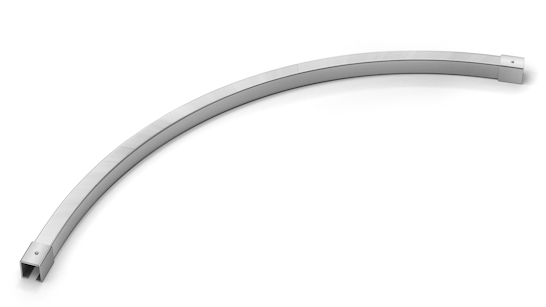
Radius Corner
By using a 90 degree radius corner you can go around obstructions or make shapes. The 24" radius corner quickly attaches and detaches as needed. Use 1 radius for an L-Shape design, 2 radius corners for a C-Shape and 4 radius corners for a complete enclosure.

Engineering Breakdown: How Track Hardware Supports Weather Barrier Systems
Once the protection challenge is understood, the next step is looking at how the track hardware supports a sliding weather barrier. These systems rely on several mechanical components that carry the curtain load and guide movement across the shed opening.

• Curtain Track Rails. Curtain track rails create the structural path that supports and guides the sliding barrier.
• Trolley Rollers. Trolley rollers allow the curtain to move smoothly along the track while distributing the curtain weight.
• Mounting Brackets and Support Points. Mounting brackets secure the track to overhead beams or structural framing.
• Track Support Spacing. Proper support spacing prevents track sagging and maintains smooth curtain operation.
How These Components Work Together
Together, these components form a stable overhead system that supports the sliding weather barrier. When properly installed, the track hardware allows the curtain to move smoothly while maintaining the strength needed to span wide tractor shed openings.
Types of Curtain Track Mounts
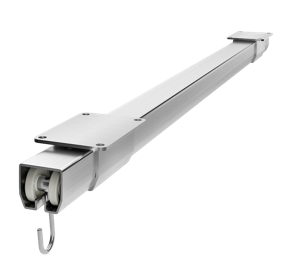
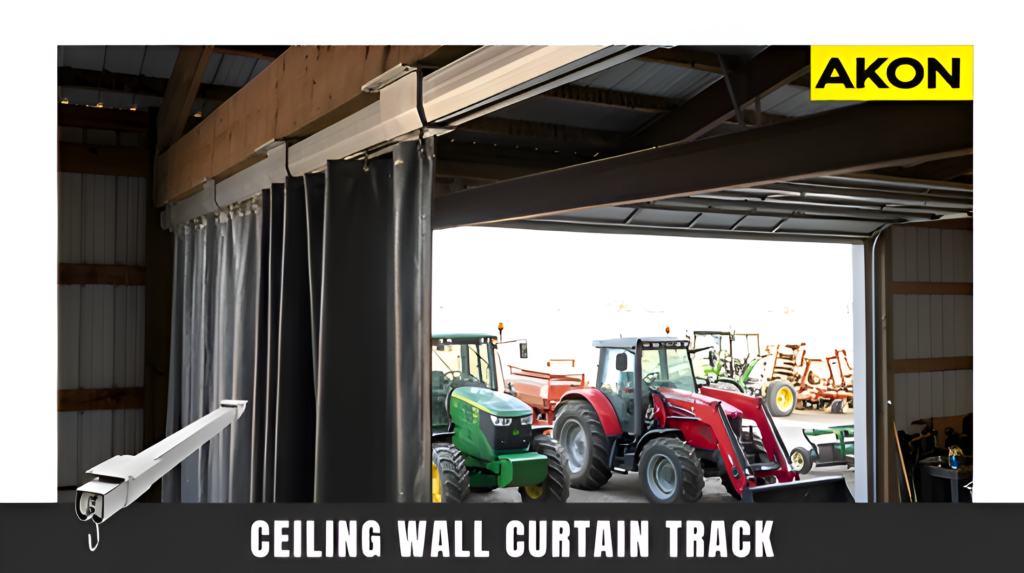
Ceiling Mount Curtain Track
Choose this mounting style if you want your industrial curtain track to mount to the ceiling with only a few inches of open gap.
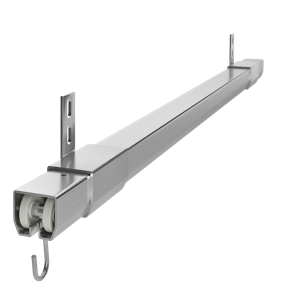
Wall Mount Curtain Track
This curtain track mount is designed for mounting the track next to a vertical wall or stud. This can be parallel to the wall, or perpendicular.
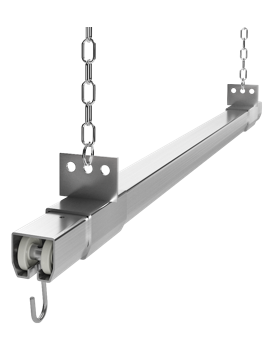
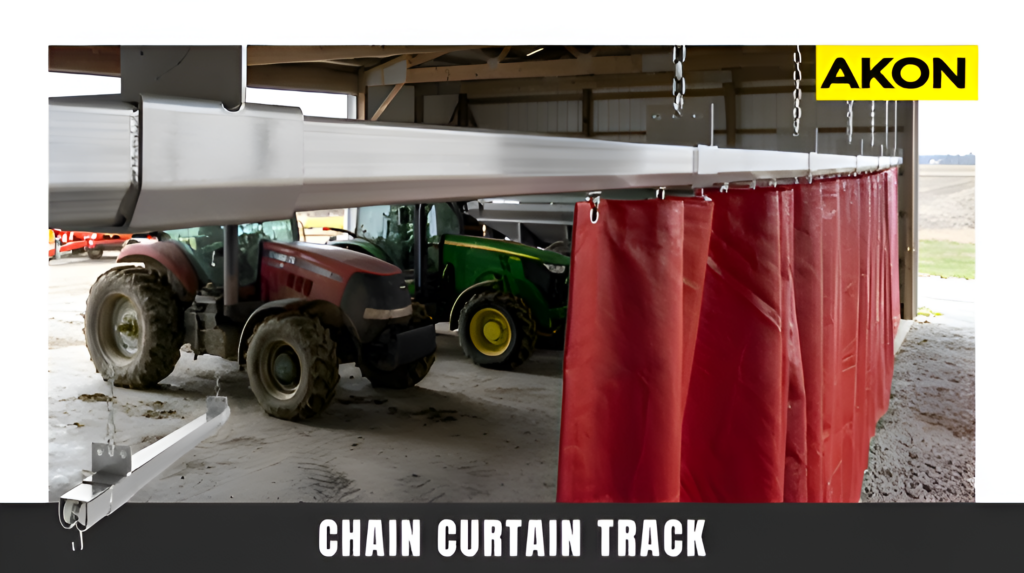
Chain or Cable Curtain Track
Like the threaded rod, a chain supported curtain track is also good for spanning large distances. Both chain or cable can be used to hold up the track.
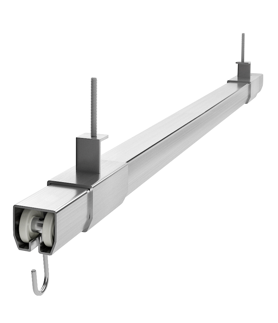
Threaded Rod Curtain Track
If the distance between the anchor points above is higher than where you want the curtain track, then a threaded rod mount might work well. Steel rods support the track and span the distance between the track and the ceiling.
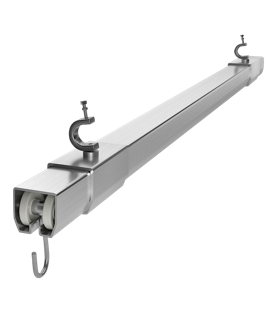
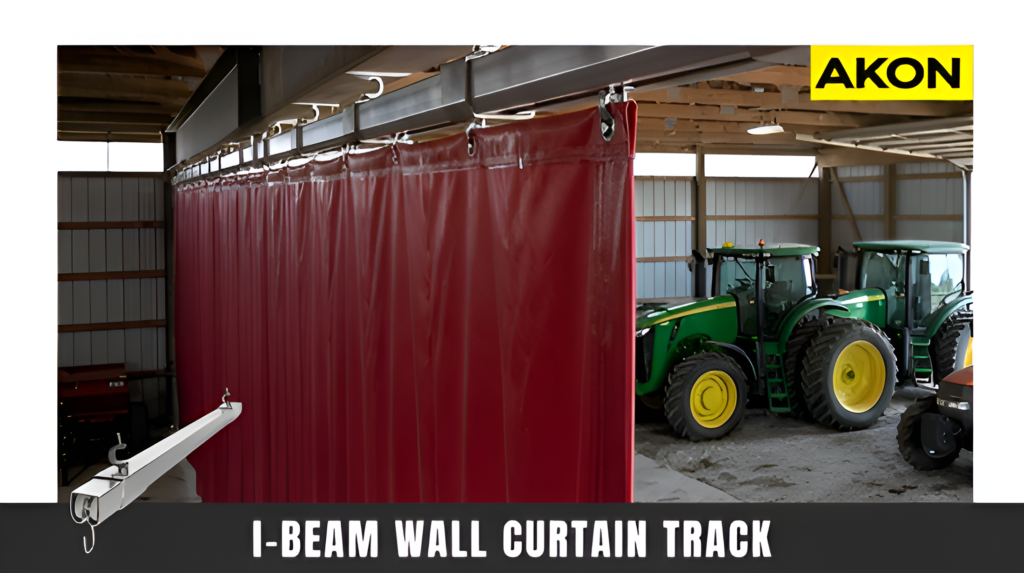
I-Beam Curtain Track
When connecting to a truss, I-Beam or any other horizontal steel support this style of mount works best. Once connected, you simply tighten down the set screw.
Choosing the Right Track System for Tractor Shed Weather Barriers
Once the hardware components are understood, the next step is selecting a track system that matches the structure and span of the tractor shed. Different mounting styles work better depending on the beam layout, opening width, and how the curtain system will operate.

A ceiling curtain track is commonly used when the system can be mounted directly to overhead beams or roof framing.
• Attaches directly to ceiling beams or structural framing.
• Creates a straight overhead path for curtain movement.
• Ideal for wide tractor shed openings where overhead mounting is available.
• Keeps the system elevated and out of the equipment pathway.

An I-beam curtain track works well in agricultural buildings that use exposed steel beams.
• Mounts directly to structural steel I-beams for strong support.
• Allows curtain panels to roll smoothly across long spans.
• Suitable for sheds with steel frame construction.
• Provides stable support for heavier curtain systems.

A chain curtain track system is designed for situations where operators need controlled manual curtain movement.
• •Uses a chain mechanism to open and close the curtain system.
• Allows even movement across long curtain spans.
• Helpful when direct pulling on the curtain is not practical.
• Useful for managing larger weather barrier curtains.
Tractor Shed Track Hardware Comparison
After knowing several track system options, it helps to compare common configurations used in agricultural buildings. Each setup supports curtain systems differently depending on the shed structure, span distance, and operating conditions inside the building.
| Track Type | Best Application | Load Capability | Installation Notes |
|---|---|---|---|
| Ceiling Mounted Track | Open tractor shed bays | High | Mounts directly to beams |
| Suspended Track | Tall farm structures | Medium–High | Clears overhead obstructions |
| Wall Mounted Track | Smaller shed openings | Medium | Easier installation |
| Heavy-Duty Roller Track | Wide agricultural spans | Very High | Supports heavier curtains |
| Evaluation Factor | Why It Matters |
|---|---|
| Building Structure | The position of beams, walls, and framing determines where the track can be securely mounted. |
| Span Distance | Larger shed spans may require stronger track systems to support curtain movement across the opening. |
| Curtain System Load | Heavier weather barriers require track systems designed to handle greater loads. |
| Environmental Exposure | Conditions such as moisture, dust, and wind can influence which track materials and mounting styles work best. |
Taking these factors into account helps ensure the curtain system operates smoothly while staying compatible with the tractor shed’s structure and daily workflow.
Frequently Asked Questions
FAQs: Track Hardware Applications for Tractor Shed Weather Barriers
Q1. What curtain track system works best for tractor shed weather barriers?
A Ceiling Curtain Track is often used because it mounts directly to overhead beams and allows weather barrier curtains to slide smoothly across large openings. In buildings with exposed steel framing, an I-Beam Curtain Track may provide stronger structural support.
Q2. How much weight can curtain track systems support in agricultural buildings?
Load capacity varies depending on the track design and mounting structure. Heavy-duty systems such as I-Beam Curtain Tracks are commonly selected for tractor sheds that use larger or heavier weather barrier curtains.
Q3. How far apart should curtain track supports be installed?
Support spacing depends on the track type, span distance, and curtain weight. Proper spacing helps maintain track alignment and ensures smooth movement of the curtain system over time.
Q4. Can curtain track systems span wide tractor shed openings?
Yes. Systems like Ceiling Curtain Track and I-Beam Curtain Track are designed to handle wide agricultural openings while supporting sliding curtain barriers.
Q5. Can track hardware be installed on an existing tractor shed?
Yes. Many tractor sheds can be retrofitted with curtain track systems by mounting the track to existing beams, framing, or wall structures.
Q6. What is the benefit of using a ceiling curtain track in a tractor shed?
A Ceiling Curtain Track keeps the curtain system mounted above equipment pathways while allowing the barrier to move across the full opening when needed.
Q7. When should an I-Beam Curtain Track be used instead of a standard ceiling track?
An I-Beam Curtain Track is commonly used in sheds with exposed steel beams where additional structural strength is needed for larger spans or heavier curtains.
Q8. What is a chain curtain track system used for?
A Chain Curtain Track allows operators to open and close larger curtain systems using a manual chain mechanism. This makes it easier to move large weather barriers across wide openings.
Q9. Can curtain tracks be used in other farm buildings besides tractor sheds?
Yes. The same track systems used in tractor sheds are often installed in barns, equipment storage buildings, and other agricultural structures.
Q10. Do tractor shed weather barriers require motorized systems?
No. Many installations use manual systems such as Chain Curtain Tracks, which allow operators to move the curtain without electric motors.
Q11. What type of curtain material is typically used with these track systems?
Weather barrier curtains are commonly made from reinforced vinyl or similar materials designed to withstand outdoor exposure and frequent movement.
Q12. Can sliding curtain systems be opened partially?
Yes. Curtain systems mounted on tracks can be positioned anywhere along the track to allow partial opening when needed.
Q13. Are curtain track systems durable enough for agricultural environments?
Yes. Industrial track systems are designed for demanding environments where moisture, dust, and temperature changes are common.
Q14. How long does it take to install a curtain track system?
Installation time varies depending on the size of the opening and the mounting structure, but many systems can be installed relatively quickly once the mounting points are prepared.
Q15. Can a curtain track system be extended later?
In many cases, track systems can be expanded or modified if the shed opening changes or additional coverage is needed.
Q16. Do curtain track systems require regular maintenance?
Most systems require minimal maintenance, typically limited to occasional inspection and cleaning of rollers and track surfaces.
Q17. Can curtain barriers help reduce dust entering the shed?
Yes. When closed, the barrier can help limit dust, wind, and debris entering the equipment storage area.
Q18. Are sliding weather barrier systems safe around tractors and farm equipment?
Yes. These systems are designed to keep the opening clear when the curtain is retracted, allowing tractors and machinery to move freely.
Q19. Can curtain systems be customized for different shed sizes?
Yes. Curtain track systems can be configured to match different building widths, spans, and mounting conditions.
Q20. How do farmers choose the right curtain track system?
The right choice depends on the building structure, span width, curtain weight, and how the barrier will be operated. Options such as Ceiling Curtain Track, I-Beam Curtain Track, and Chain Curtain Track can each be selected based on these factors.
Choosing the Right Track Hardware for Tractor Shed Weather Barriers
Tractor sheds need protection that works alongside daily farm operations without blocking equipment movement. Sliding weather barrier systems supported by durable curtain track hardware allow farms to shield tractors and implements from weather while keeping large openings accessible. By choosing a track configuration that fits the building structure, curtain system load, and opening width, operators can improve equipment protection while maintaining smooth and efficient workflow inside the shed.
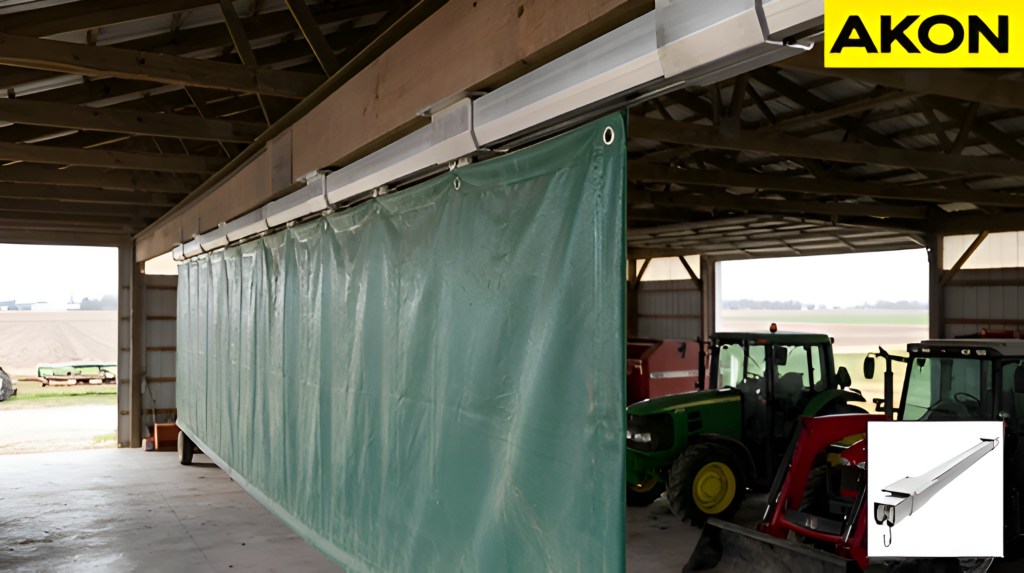
Overhead Curtain Track System Installed in a Tractor Shed

Photo Gallery