
Impact-Resistant Curtain Tracks
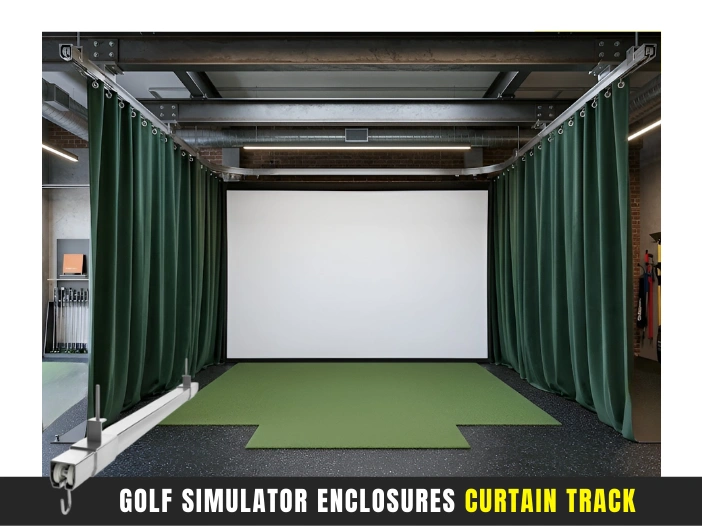
Golf simulators generate repeated high-velocity impacts that introduce structural stress into enclosure systems. While the curtain absorbs the ball’s force, the track carries the load. This article explores failure mechanics, engineering design principles, and track system architectures required to maintain span stability, proper mounting, and long-term performance.
Failure Mechanics: What Actually Causes Track Systems to Break
When a curtain track operates under repeated motion, mechanical stress concentrates in predictable areas. In golf simulator enclosures, breakdown typically develops gradually through vibration, movement cycles, and uneven load distribution.
Reason 1: Stress Concentration at Brackets
• Over-spaced supports force excessive load onto limited mounting points.
• Brackets absorb concentrated stress where they connect to framing.
• Repeated motion amplifies strain at those isolated anchor locations.
Reason 2: Span Deflection
• Extended, unsupported track runs gradually bend under repeated movement.
• Minor flex increases friction and disrupts alignment over time.
• Continued deflection transfers additional strain to adjoining hardware.
Reason 3: Fastener Shear & Pull-Out
• Anchoring into drywall rather than structural framing reduces stability.
• Undersized fasteners cannot withstand ongoing vibration cycles.
• Progressive loosening shifts system alignment and increases stress.
Reason 4: Open Channel Derailment
• Lateral curtain movement can shift trolley carriers out of alignment.
• Sudden motion may lift rollers in open-channel designs.
• Misalignment increases operational resistance and accelerates wear.
Make Shapes
Radius Corner
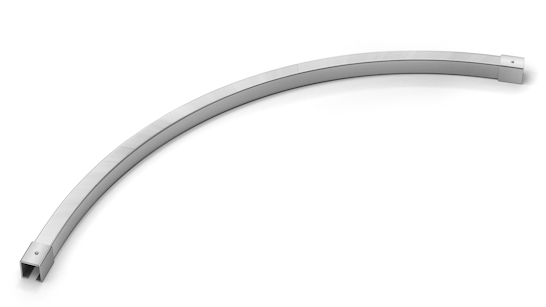
By using a 90 degree radius corner you can go around obstructions or make shapes. The 24" radius corner quickly attaches and detaches as needed. Use 1 radius for an L-Shape design, 2 radius corners for a C-Shape and 4 radius corners for a complete enclosure.

Engineering Principles Behind an Impact-Ready Track System
Preventing mechanical breakdown starts with thoughtful structural planning. An impact-ready track system is designed to manage movement cycles, maintain alignment, and support consistent performance across its full span.
• Static curtain weight remains constant, but repetitive movement shifts force across the track during operation.
• Joist-mounted installations typically use 16–24 inch bracket intervals to maintain structural consistency.
• Extended runs may require mid-span reinforcement to maintain linear stability.
• Enclosed track channels guide rollers within a controlled path during movement.
When these engineering principles are applied correctly, the result is a track system that operates predictably under repeated use. The next step is understanding how different track architectures implement these principles in real-world golf simulator installations.
Types of Curtain Track Mounts
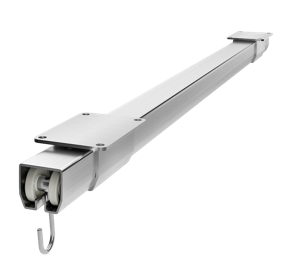
Ceiling Mount Curtain Track
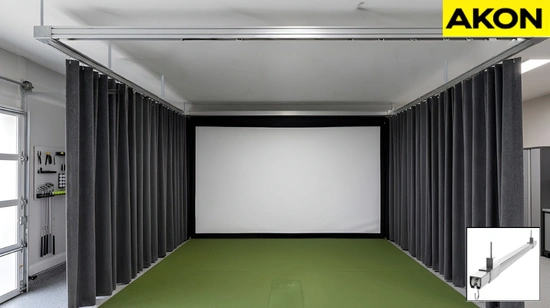
Choose this mounting style if you want your industrial curtain track to mount to the ceiling with only a few inches of open gap.
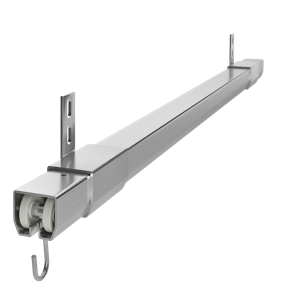
Wall Mount Curtain Track
This curtain track mount is designed for mounting the track next to a vertical wall or stud. This can be parallel to the wall, or perpendicular.
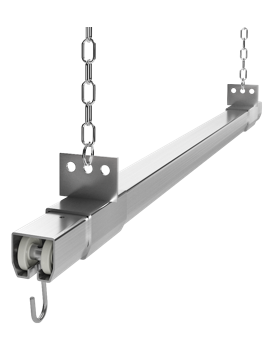
Chain or Cable Curtain Track
Like the threaded rod, a chain supported curtain track is also good for spanning large distances. Both chain or cable can be used to hold up the track.
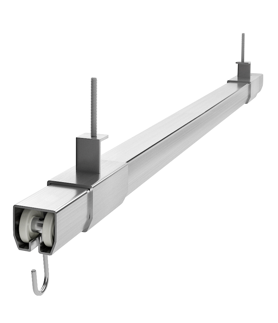
Threaded Rod Curtain Track
If the distance between the anchor points above is higher than where you want the curtain track, then a threaded rod mount might work well. Steel rods support the track and span the distance between the track and the ceiling.
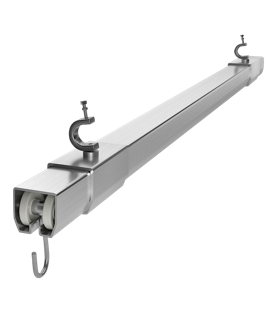
I-Beam Curtain Track
When connecting to a truss, I-Beam or any other horizontal steel support this style of mount works best. Once connected, you simply tighten down the set screw.
System Architecture: Track Platforms Built for Golf Simulator Applications
With the structural design principles defined, the next step is selecting a track architecture that fits the physical layout of the simulator space. Different overhead systems apply those principles in distinct ways depending on span length, mounting access, and movement requirements.

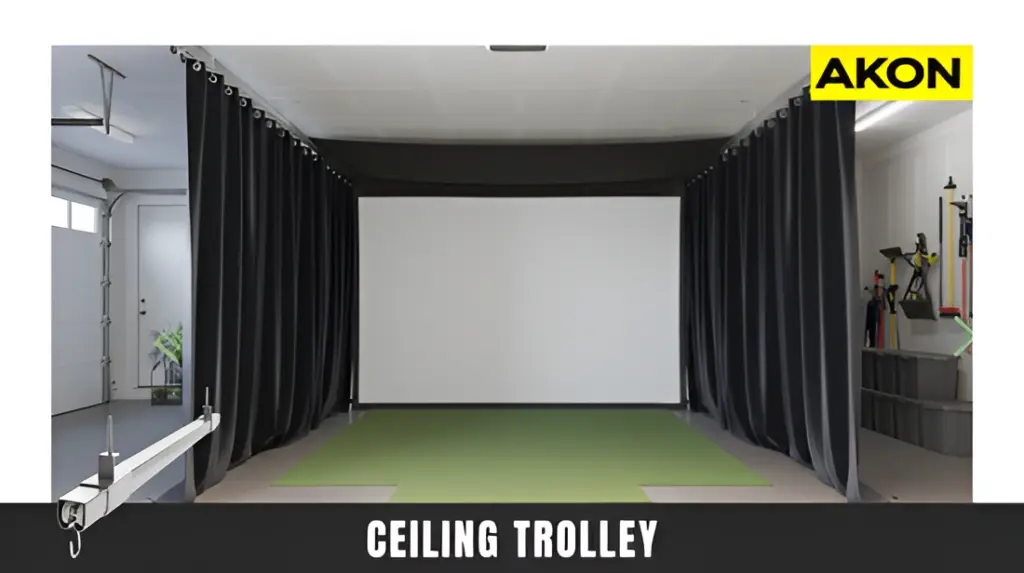
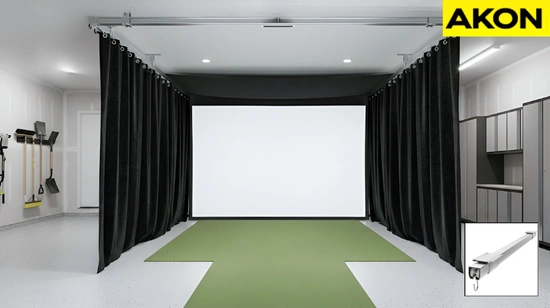
The Ceiling Trolley platform supports smooth overhead curtain movement while maintaining controlled alignment. For golf simulator enclosures where curtains need to open and close frequently, this system provides consistent tracking within a fixed ceiling structure.
• Retractable simulator enclosures
• Permanent ceiling-mounted installations
• Enclosed overhead trolley system
• Guided roller movement within a defined track path

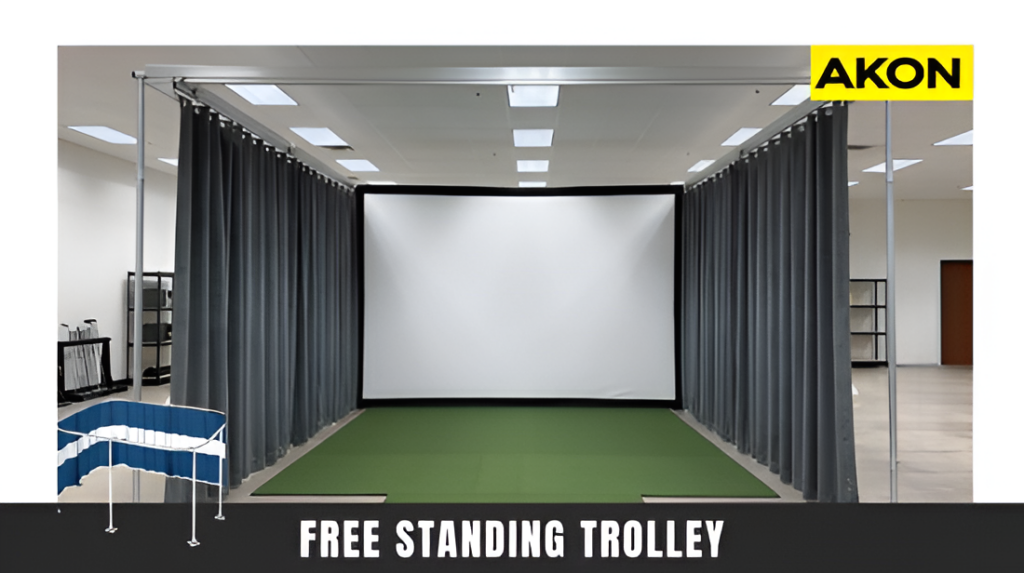
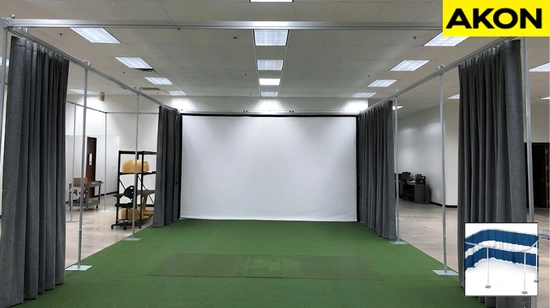
The Free Standing Trolley system removes dependency on ceiling joists or beams. This architecture allows simulator enclosures to operate within a self-supporting framework, making it ideal for flexible or temporary installations.
• Multi-use garages
• Spaces without suitable ceiling framing
• Frame-supported overhead rail
• Independent structural configuration

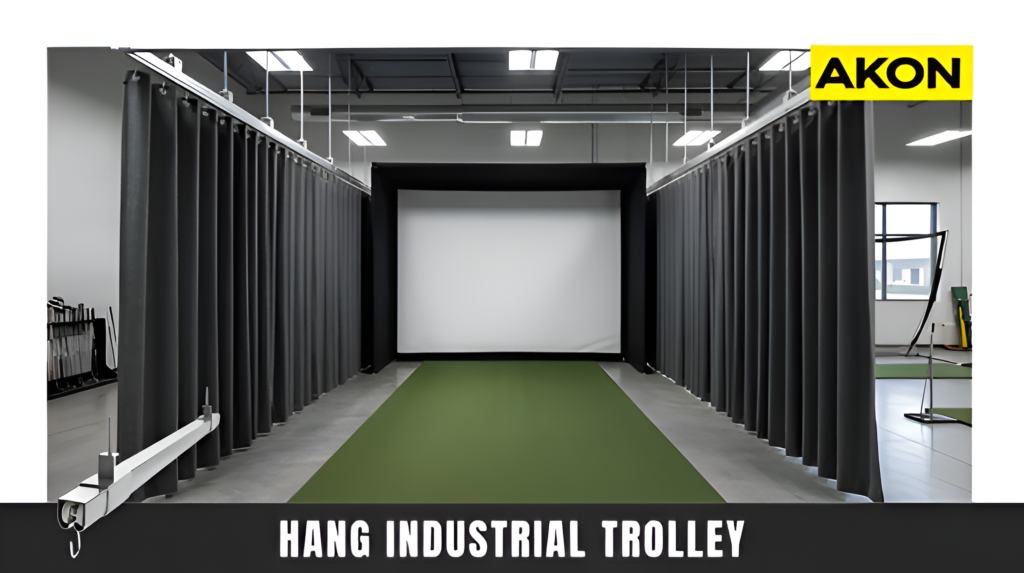
The Hang Industrial Curtains system lets you suspend and move full-length curtains along an overhead trolley track, making it ideal for enclosing impact zones and dividing simulator space. These tracks are made from heavy-gauge, rust-resistant galvanized steel and are built to handle rugged use in overhead curtain applications
• Creating full-coverage golf simulator enclosures
• Heavy curtain deployment on overhead track systems
• Galvanized steel curtain track sections designed to hang industrial-grade curtains
• Heavy-duty roller hangers allow smooth movement along the track
System Selection Matrix: Choose Based on Structure & Usage
Now that the available track architectures are defined, the next step is aligning the system with your physical installation conditions. Select your track system based on structural mount type, span length, and projected usage level.
| Environment Type | Structural Mount | Span Length | Impact Frequency | Recommended System | Rationale |
|---|---|---|---|---|---|
| Residential Garage | Wood Joists | 10–20 ft | High | Industrial Curtain Track | Optimized for extended run lengths and active environments |
| Basement Setup | Concrete Beam | 8–14 ft | Moderate | Ceiling Trolley | Stable overhead configuration within fixed structures |
| Multi-Use Room | No Ceiling Access | Variable | Variable | Free-Standing Trolley | Independent frame-based installation |
| Commercial Simulator | Structural Steel | 15+ ft | Continuous | Heavy-Duty Industrial Track | Built for sustained, high-volume operation |
This matrix serves as a practical decision guide, aligning each track system with real installation conditions such as mounting surface, span length, and usage level. By assessing how your simulator space is constructed and how frequently it will operate, you can confidently identify the most structurally appropriate solution for your setup.
Frequently Asked Questions
FAQs: About Golf Simulator Curtain Track Installations
1. What is the correct bracket spacing for a 14-foot golf simulator curtain track?
Bracket spacing should follow manufacturer guidelines and align with structural framing. For longer garage spans, the Industrial Curtain Track system is typically configured to maintain consistent overhead support across the full run.
2. What happens if mounting brackets are spaced too far apart on a simulator track?
Excess spacing can cause gradual alignment drift and increased movement resistance. Properly installed Industrial Curtain Track or Ceiling Trolley systems rely on consistent support intervals to maintain smooth operation.
3. Can I combine ceiling and wall mounting in one golf simulator enclosure?
Yes, hybrid installations are possible when structural framing varies. Ceiling Trolley systems are often used in fixed overhead sections, while other track configurations can transition along walls when required.
4. How do I prevent trolley derailment in a golf simulator curtain system?
Maintaining straight alignment and using enclosed overhead systems reduces misalignment risk. The Ceiling Trolley platform keeps roller carriers guided within a defined track path for consistent movement.
5. How long does a galvanized steel curtain track last in a garage simulator?
Galvanized steel track systems used in indoor golf simulator enclosures are corrosion-resistant and built for long-term durability when properly installed in controlled environments.
6. Can I expand my golf simulator track system later?
Yes. Modular systems such as the Industrial Curtain Track and Free Standing Trolley allow additional sections to be integrated as your enclosure grows or changes.
7. Do longer golf simulator spans require heavier-duty track systems?
Extended spans typically require structurally rated overhead systems. The Industrial Curtain Track is commonly selected for longer residential and commercial simulator builds.
8. Is mid-span reinforcement necessary for an 18-foot garage simulator?
For longer garage builds, additional support points may be recommended depending on framing conditions. Evaluating your joist or beam layout ensures structural consistency.
9. Can I mount a golf simulator curtain track directly into concrete?
Yes, when using appropriate anchors rated for structural loads. Ceiling Trolley systems can be installed into concrete beams with proper fastening hardware.
10. Is a Free Standing Trolley strong enough for a full golf simulator enclosure?
Yes. The Free Standing Trolley system is designed to operate independently of ceiling framing and is suitable for multi-use rooms or non-permanent installations.
11. What makes an Industrial Curtain Track different from a standard curtain rod?
Industrial Curtain Track systems are engineered for structural overhead applications, unlike decorative rods which are not designed for high-use enclosure environments.
12. Can I use a Hose Festoon system in a golf simulator setup?
Yes. A Hose Festoon system helps manage overhead cables such as projector lines or power cords, keeping them aligned and clear of curtain movement.
13. How much clearance should I leave above the curtain track?
Allow enough vertical space for trolley movement and any overhead obstructions. Clearance planning ensures uninterrupted enclosure operation.
14. Can I curve or angle a track system in a simulator room?
Yes, certain overhead track configurations can adapt to angled layouts. Planning should account for structural continuity across transitions.
15. Is professional installation required for an overhead trolley track?
DIY installation is possible when structural framing is accessible and properly measured. Larger or commercial simulator builds may benefit from professional evaluation.
16. How do I keep a golf simulator curtain track aligned over time?
Accurate installation, proper fastening, and periodic inspection of mounting hardware help maintain consistent overhead alignment.
17. Does impact frequency affect track system selection?
Yes. Higher usage environments, such as commercial simulators, typically require structurally rated systems like the Industrial Curtain Track.
18. Can I install lighting or electrical accessories along the same track?
Electrical components should be supported independently or managed using systems like the Hose Festoon to prevent interference with curtain movement.
19. What is the first step before ordering a golf simulator curtain track?
Measure your full span, confirm mounting surface type, and identify structural framing locations before selecting a system.
20. Which track system is best for a DIY garage golf simulator enclosure?
For most residential garage builds with wood joists and spans between 10 and 20 feet, the Industrial Curtain Track or Ceiling Trolley systems are commonly selected based on layout and usage needs.
Designing a Structurally Sound Golf Simulator Enclosure
A reliable golf simulator enclosure begins with evaluating structure first and materials second. Span length, mounting surface, and system load capacity should guide your track selection from the outset. When the chosen architecture matches the physical conditions of the space, the enclosure operates consistently and maintains stability over time. Proper planning at the structural level ensures dependable performance with every session.
Golf Simulator Enclosure System Layout

Photo Gallery