

Track Load & Sag, Made Simple
A plain-language guide to reading the original AKON 16RT load charts, so you can see how much weight your industrial curtain track can carry and how far it will bend between supports.
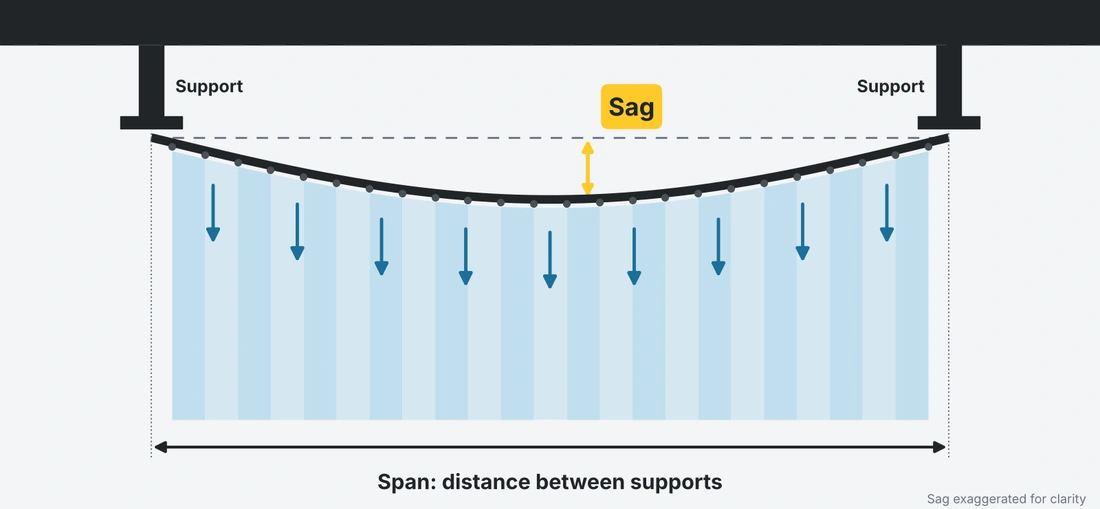
Start with the Distance Between Supports
The span is not the total track length
The span is the open distance from one support (ceiling bracket or hanger) to the next. Always read the charts using the span you are checking, not the overall length of the track run.
Two Ways Weight Can Hang from the Track


Weight spread out
A curtain spread evenly across the span. These charts read the weight in pounds per foot (lb/ft).
Weight at one point
One load hanging at the middle of the span, like a hose, cable or tool hung from overhead trolley track. These charts read the weight in total pounds (lb).
What Does "Sag" Mean?
Sag (also called deflection) is how far the track bends downward under weight. A smaller sag value means a straighter track, smoother-running carriers and a curtain that hangs level.
Closer supports generally mean less sag
Identify your track model, then choose the chart that matches how the weight is carried. Check both the sag curve and the dashed stress-limit line.
How to Use the Charts
- Find your support spacing (in feet) along the bottom of the chart.
- Move straight up to the sag curve you want (for example 1/4 in.).
- Read the weight at the left. Your load must stay below both that sag curve and the dashed stress-limit line.
The weight scale on every chart is logarithmic, so use the labeled values rather than measuring by eye between gridlines.
16RT Track Load and Sag Charts
16RT is AKON's 16-gauge curtain track. Tap or click a chart to enlarge it.
16RT | Weight Spread Out
Evenly distributed load between supports.
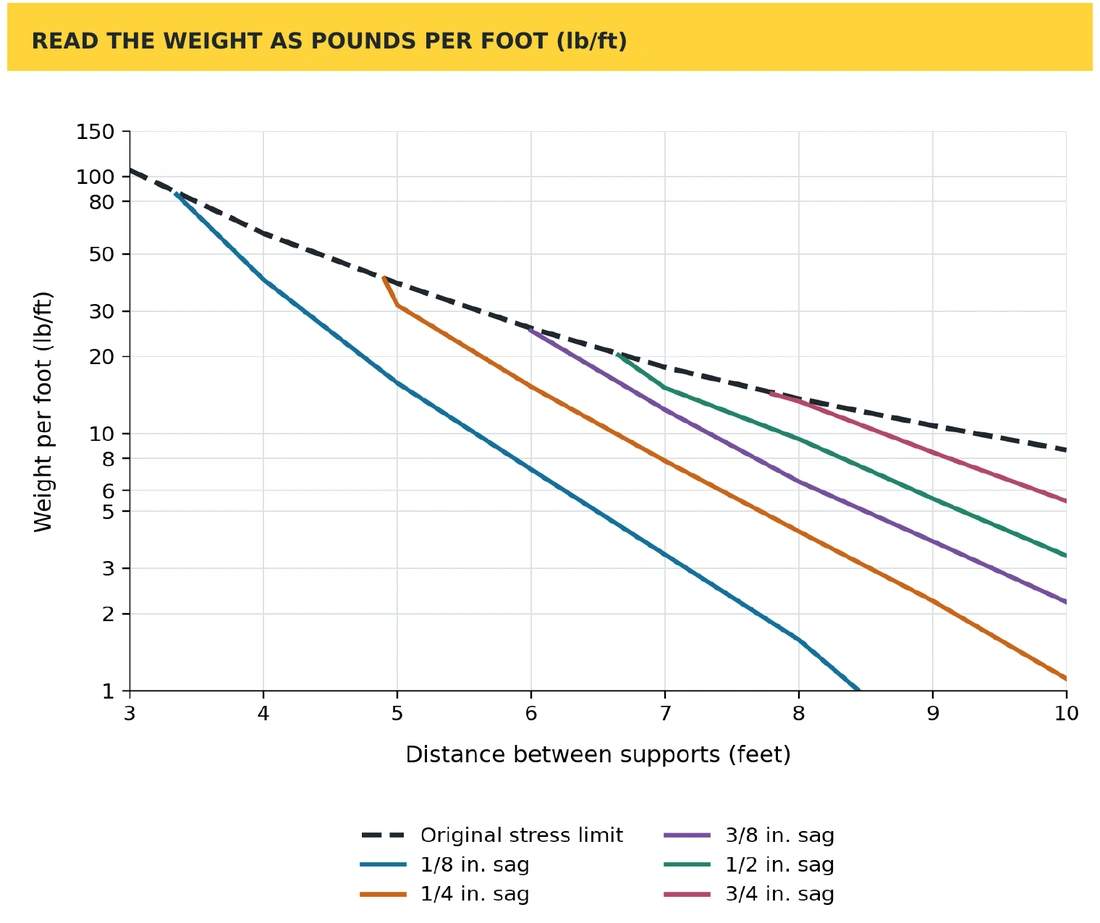
Read the weight as pounds per foot. If the curtain bunches up when open, also review the center-load case.
16RT | Weight at the Center
Entire load at one point midway between supports.
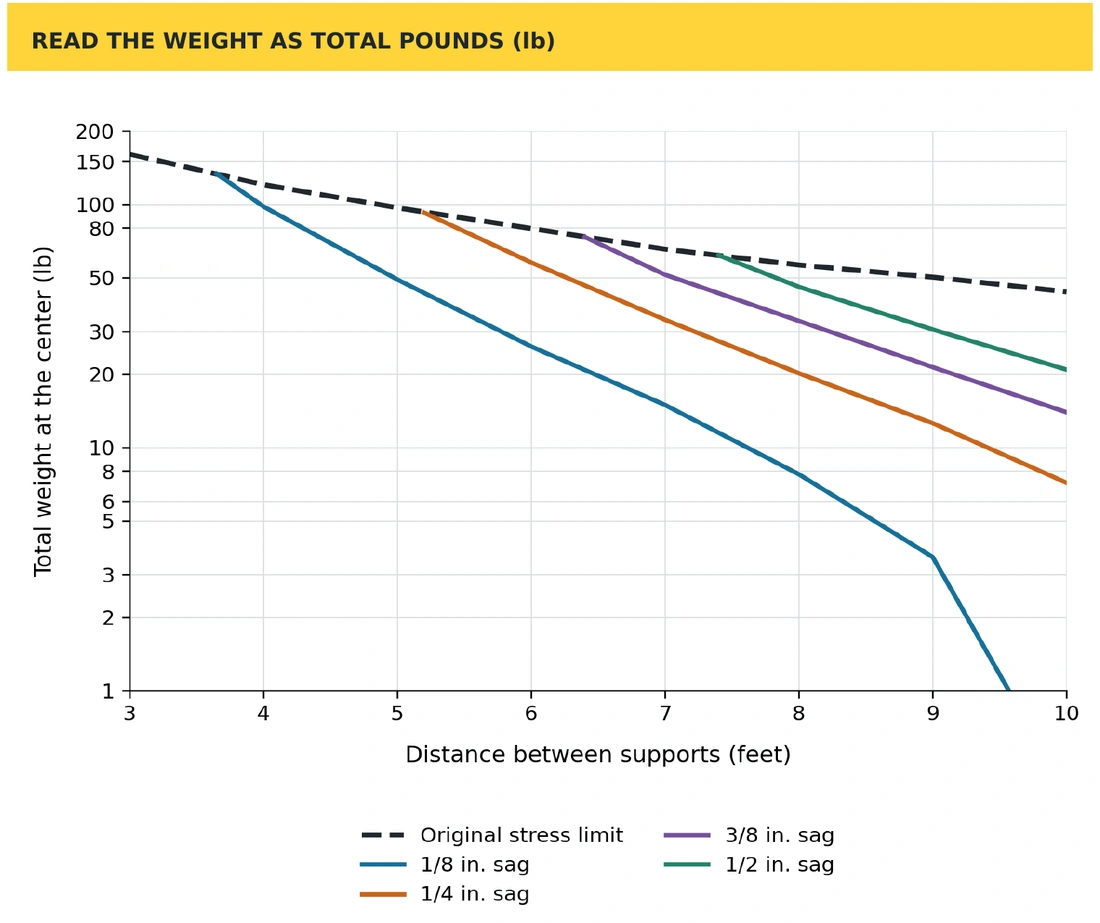
Read the weight as total pounds. A partly bunched curtain falls between the two load cases; ask AKON to confirm the layout.
Put the Charts into Practice
Same Weight. Different Chart.
Example A: a curtain spread evenly
A 60 lb curtain spread over a 6 ft span gives 60 ÷ 6 = 10 lb/ft. Use the "Weight spread out" chart at 6 ft and 10 lb/ft.
Example B: a load at the center
A 60 lb load hanging at the middle of a 6 ft span is a 60 lb center load. Use the "Weight at the center" chart at 6 ft and 60 lb.
These examples explain the units only. They are not approvals for a particular track or installation.
What the Original Charts Assume
The original curves are based on a maximum track stress of 15,000 psi. The source states a 30,000 psi yield stress for its low-carbon steel: a factor of safety of 2:1 against yielding and 3:1 against ultimate tensile strength.
In plain language, those margins belong to the original track calculations. They are not permission to double or triple the chart loads.
The source calls for more conservative design where those margins are inadequate, specifically for high installations and areas near catwalks or maintenance access.
Confirm the Complete Installation
Track sag is only one check. Confirm the track model, rollers, brackets, connections, anchors and supporting structure for the actual load and layout. Not sure which chart applies to your curtain? Contact AKON and we will help you size the track and support spacing.
Charts are approximate visual tracings of AKON's legacy track deflection chart and track specification catalog. They are not new tested load ratings. Confirm final sizing with AKON.