
Warehouse Pick Line Trolley Track
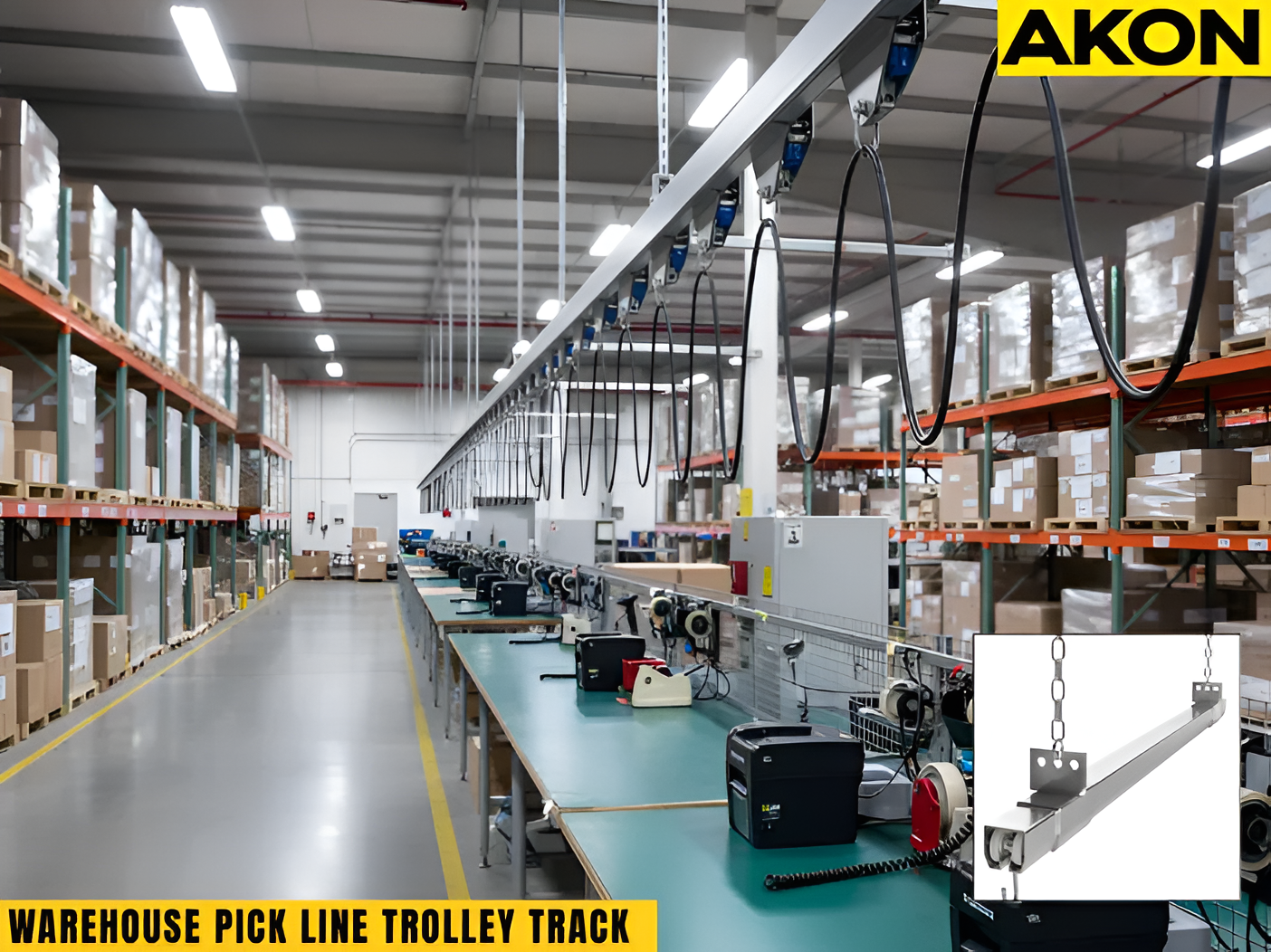
A Warehouse Pick Line Trolley Track is an overhead enclosed rail system used in warehouses, industrial facilities, and workshops to move materials between work zones. It supports pick lines, assembly stations, fabrication areas, and staging lanes. This article outlines the operational challenges it addresses, how it improves workflow, and the configurations and components suited for industrial use.
Operational Challenges in Warehouse and Workshop Pick Lines
After knowing what a pick line trolley track is, it helps to look at what often slows internal movement in industrial environments. In both warehouses and workshops, material flow between stations can quietly impact productivity long before it becomes obvious.
Excess Movement and Floor Congestion
In many facilities, workers move materials across long horizontal distances throughout the day. Travel between storage, fabrication, assembly, picking, and staging areas consumes time that does not directly add value. As volume increases, carts, forklifts, and pallet jacks begin sharing the same aisles as technicians and pickers.
This shared space creates crowding, slows navigation, and increases workflow interruptions. Even organized layouts can feel strained when floor traffic becomes the primary method of material transfer.
Stop-and-Start Flow and Growth Limitations
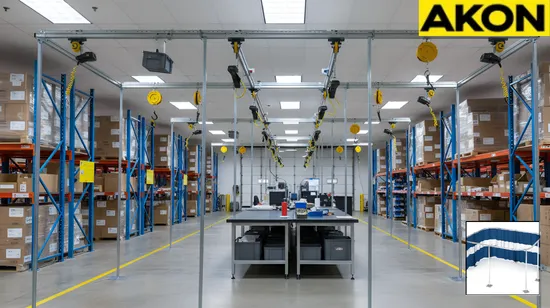
Movement between departments often lacks steady rhythm. Materials may pause between zones while waiting for space, clearance, or available transport paths. These interruptions disrupt coordination between fabrication, packing, and shipping operations.
As production or order volume expands, small delays compound into larger bottlenecks. Systems originally designed for lighter demand may struggle under higher throughput, limiting flexibility and reducing overall operational efficiency.
Make Shapes
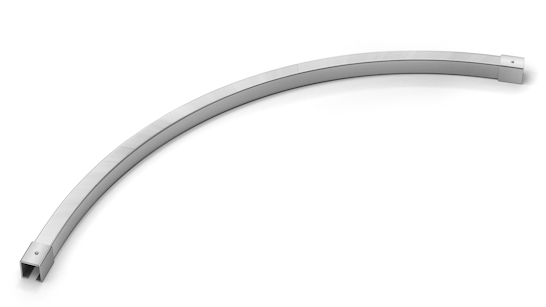
Radius Corner
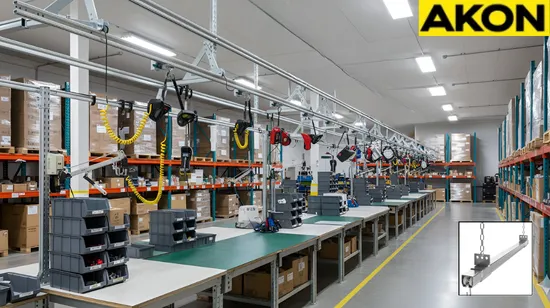
By using a 90 degree radius corner you can go around obstructions or make shapes. The 24" radius corner quickly attaches and detaches as needed. Use 1 radius for an L-Shape design, 2 radius corners for a C-Shape and 4 radius corners for a complete enclosure.

How a Pick Line Trolley Track Improves Industrial Workflow
Once movement paths are intentionally structured, coordination across departments becomes more predictable. A pick line trolley track introduces a fixed overhead route that connects work zones through a guided rail system. This creates a controlled transfer pathway that supports consistent internal movement across warehouse and workshop operations.
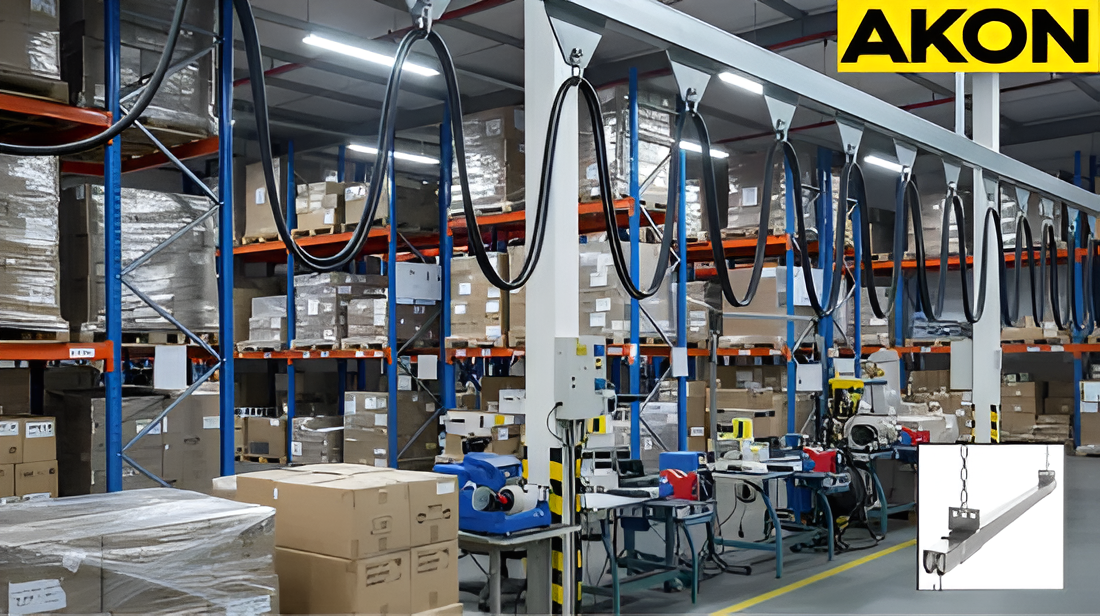
• Defined transfer lanes. Establishes a dedicated route for internal material movement. This improves routing consistency and reduces reliance on temporary floor pathways.
• Improved workspace organization. Encourages clearer separation between active work areas and transport functions. As a result, teams can operate without constant adjustments to shared space.
• Greater layout flexibility. Allows routing to follow production sequencing rather than floor constraints. Facilities can adapt movement paths as workflow requirements evolve.
Increased Throughput Across Work Zones
Creates a direct overhead transfer path that supports steady progression between stations.
Reduced Floor Traffic Conflicts
Shifts material transport above active work areas to stabilize aisle activity.
Smoother Cross-Department Coordination
Improves alignment between fabrication, packing, and staging processes.
Track Configuration Comparison for Warehouse and Workshop Layouts
Selecting the right track configuration is a critical step once an overhead trolley system is being considered. Every warehouse and workshop layout is different, and factors such as building structure, department placement, and routing requirements will determine how the system should be installed. The goal is to align the track layout with how materials move through your facility.
| Configuration Type | Operational Purpose | Primary Advantage | Best For |
|---|---|---|---|
| Straight Track Runs | Linear material flow | Efficient long transfers | Warehouses, assembly lines |
| Curved / Radius Sections | Multi-zone routing | Layout flexibility | Fabrication shops |
| Ceiling Mounted Systems | Space optimization | Clear floor work areas | High-traffic workshops |
| Beam-Supported Systems | Retrofit installs | Structural adaptability | Older industrial buildings |
Straight track runs are typically used where departments align in a direct path. Curved sections allow routing around structural columns, machinery, or divided work zones. Ceiling-mounted systems are common in facilities designed for overhead integration, while beam-supported systems provide practical solutions in buildings with varied structural conditions. Choosing the appropriate configuration ensures the track system supports your workflow without disrupting existing operations.
Types of Curtain Track Mounts
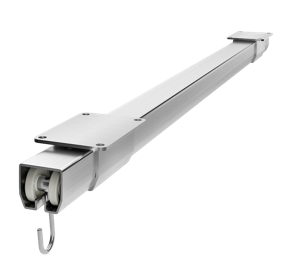
Ceiling Mount Curtain Track
Choose this mounting style if you want your industrial curtain track to mount to the ceiling with only a few inches of open gap.
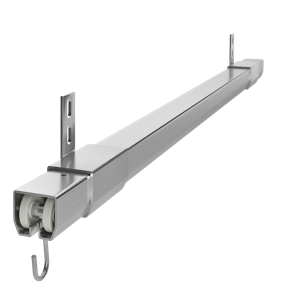
Wall Mount Curtain Track
This curtain track mount is designed for mounting the track next to a vertical wall or stud. This can be parallel to the wall, or perpendicular.
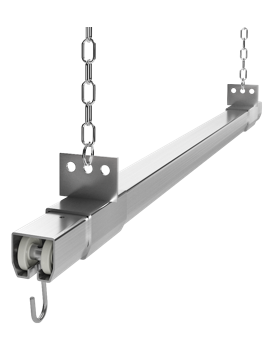
Chain or Cable Curtain Track
Like the threaded rod, a chain supported curtain track is also good for spanning large distances. Both chain or cable can be used to hold up the track.
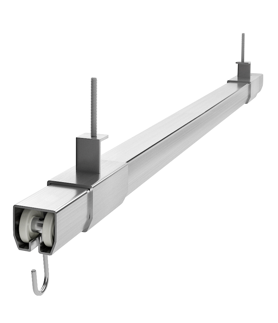
Threaded Rod Curtain Track
If the distance between the anchor points above is higher than where you want the curtain track, then a threaded rod mount might work well. Steel rods support the track and span the distance between the track and the ceiling.
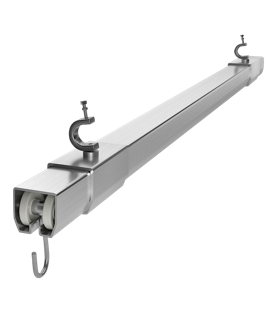
I-Beam Curtain Track
When connecting to a truss, I-Beam or any other horizontal steel support this style of mount works best. Once connected, you simply tighten down the set screw.
Recommended Overhead Track Solutions
After knowing the appropriate configuration, selecting the right system components ensures long-term performance in industrial environments.
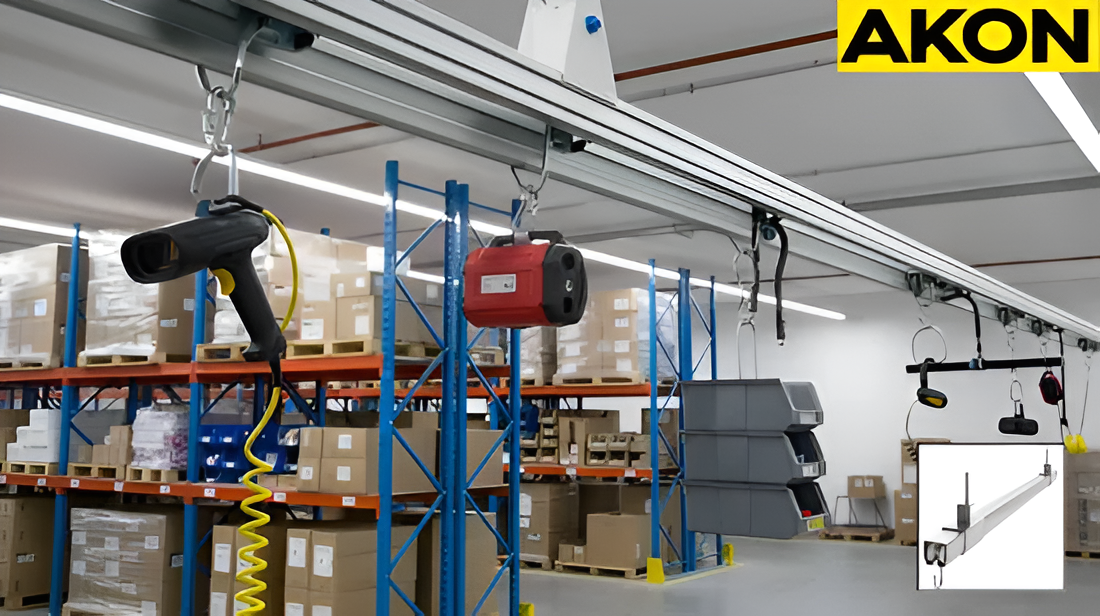
Ceiling Trolley
The Ceiling Trolley system serves as a primary overhead routing solution for industrial facilities. It is designed to support structured material movement across defined work zones.
• Heavy-duty galvanized steel construction for continuous industrial use
• Enclosed track design that protects internal rolling components
• Suitable for long linear routing in warehouse pick lines
• Compatible with straight runs and directional changes
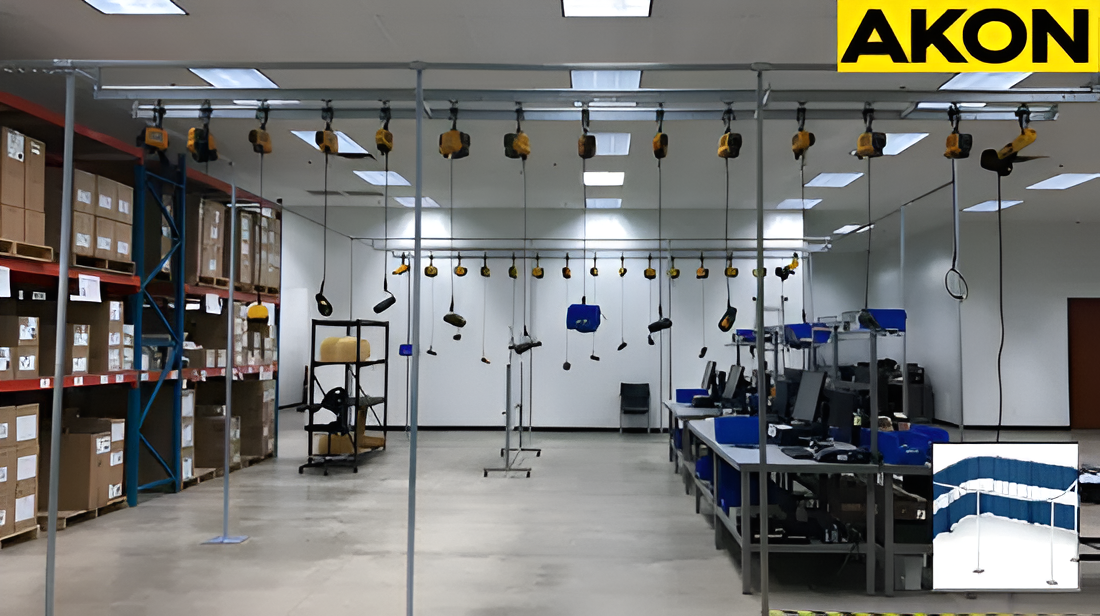
Free Standing Trolley
The Free Standing Trolley system provides overhead routing without requiring direct ceiling attachment. It is well suited for workshops or facilities with structural mounting limitations.
• Self-supported frame design for independent installation
• Practical solution for retrofit or older industrial buildings
• Allows guided overhead routing without permanent structural modification
• Adaptable to evolving floor layouts and production changes
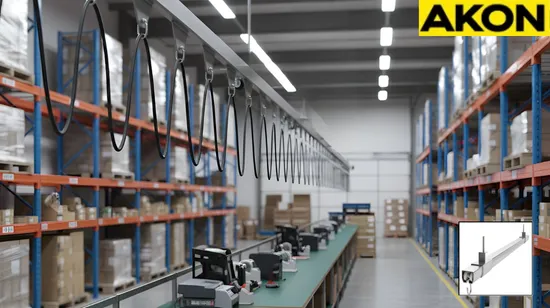
Overhead Electrical Cord Trolley
The Overhead Electrical Cord Trolley supports organized overhead routing for power and utility lines. It complements material movement systems in industrial and workshop environments.
• Keeps electrical cords elevated and properly managed
• Reduces floor-level interference from power lines
• Modular clamp-together construction for flexible layouts
• Built to withstand demanding industrial conditions
Frequently Asked Questions
FAQs: About Warehouse Pick Line Trolley Track Systems
Is a Warehouse Pick Line Trolley Track suitable for heavy industrial environments?
Yes. A Warehouse Pick Line Trolley Track system, especially when paired with a Ceiling Trolley, is built using galvanized steel and industrial-grade components designed for continuous use in demanding facilities.
Can a Ceiling Trolley system support fabrication or assembly operations?
Yes. A Ceiling Trolley can route materials between fabrication bays and assembly stations, supporting structured overhead movement in industrial workshops.
What load capacities are available for industrial overhead trolley systems?
Load capacity depends on the track design and trolley type. Heavy-duty Ceiling Trolley and Free Standing Trolley systems are engineered to handle typical warehouse and fabrication material weights.
Can a Free Standing Trolley be installed in workshops with exposed beams?
Yes. A Free Standing Trolley does not rely on ceiling attachment and can be installed in facilities with exposed framing or structural limitations.
How does a Warehouse Pick Line Trolley Track compare to a conveyor system?
Unlike fixed conveyors, a Warehouse Pick Line Trolley Track allows flexible routing and easier layout adjustments without extensive structural modification.
Is structural reinforcement required for a Ceiling Trolley installation?
In many cases, existing beams or ceiling supports are sufficient. Installation requirements depend on load expectations and building structure.
Can the system expand as production demand increases?
Yes. Modular track sections allow additional routing paths to be added as warehouse or workshop operations grow.
Does a Warehouse Pick Line Trolley Track require electrical power?
Standard trolley systems operate manually and do not require power. However, they can integrate with powered accessories such as an Overhead Electrical Cord Trolley.
How much ceiling height is required for installation?
Clearance requirements vary based on load size and trolley configuration. Most industrial buildings provide adequate height for Ceiling Trolley installations.
Is this system practical for smaller workshops?
Yes. Both Ceiling Trolley and Free Standing Trolley systems can be scaled to fit compact workshop layouts.
Can radius sections be used to route around machinery?
Yes. Radius track sections allow directional changes to accommodate equipment, structural columns, and divided work zones.
What buildings are best suited for Ceiling Trolley systems?
Steel-frame and beam-supported industrial buildings are commonly compatible with Ceiling Trolley installations.
Can multiple trolleys operate on the same track line?
Yes. Multiple trolley carriers can travel along a single track path depending on spacing and load requirements.
Can a Warehouse Pick Line Trolley Track integrate with electrical management systems?
Yes. An Overhead Electrical Cord Trolley can operate alongside a Warehouse Pick Line Trolley Track to manage power lines and utilities overhead.
What maintenance is required for industrial trolley systems?
Routine inspection of mounting hardware and trolley wheels is typically sufficient to maintain performance in workshop environments.
Is galvanized steel necessary for industrial use?
Galvanized steel provides corrosion resistance and structural durability, making it suitable for warehouse and fabrication settings.
Can a Free Standing Trolley system be used in retrofit projects?
Yes. The Free Standing Trolley is particularly useful in older industrial buildings where ceiling mounting options may be limited.
How do I choose between a Ceiling Trolley and a Free Standing Trolley?
The decision depends on building structure and mounting options. Ceiling Trolley systems attach to overhead supports, while Free Standing Trolley systems operate independently.
Is a Warehouse Pick Line Trolley Track compatible with hose management systems?
Yes. Overhead routing systems can integrate with hose festoon or Overhead Electrical Cord Trolley setups in industrial workshops.
How do I determine the right overhead trolley configuration for my facility?
Evaluating building structure, routing needs, load expectations, and expansion plans will help determine whether a Ceiling Trolley, Free Standing Trolley, or integrated system is most appropriate.
Photo Gallery
Building a Scalable Overhead Movement System for Industrial Operations
A Warehouse Pick Line Trolley Track system provides a structured overhead framework that supports organized warehouse and workshop operations while keeping floor areas clear for equipment and personnel. By incorporating scalable components such as Ceiling Trolley and Free Standing Trolley systems, facilities can implement an overhead movement solution that adapts as operational demands evolve. Evaluating your building structure, routing requirements, and long-term production goals is the first step toward implementing an industrial overhead trolley track system designed for sustained performance.
Industrial Overhead Trolley Track
